
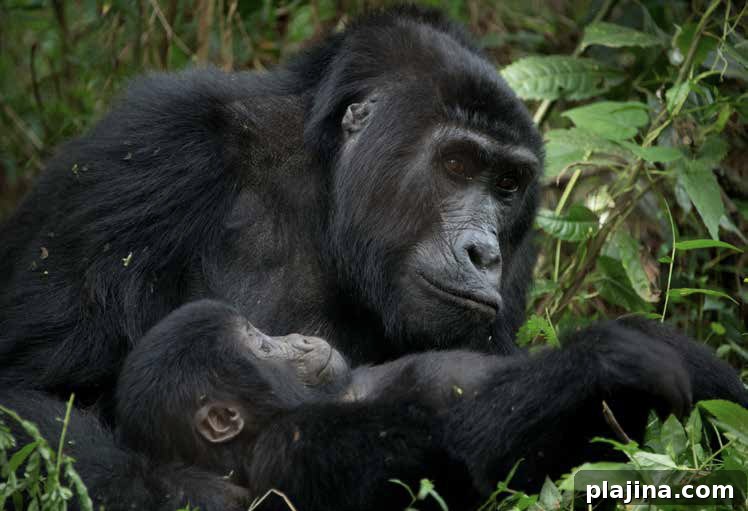
As I stare into the eyes of a 400-plus-pound silverback, I feel a quiet connection, a Zen-like moment suspended in the forest. The male gorilla reclines in the leafy understory while a handful of playful infants stir a commotion above in the treetops. Unbothered, he closes his eyes, checks the nails on his weathered hands, shifts his weight and returns to sleep as the youngsters bound and tumble overhead.
The juveniles perform for us, swinging from branches and showing off acrobatic antics. Around the bend, mothers with babies and adolescents appear, as curious about our presence as we are about theirs. One juvenile spins and twirls, dizzying himself until he collapses in a heap, then grins at the attention.
“He’s drunk on heliconia leaves,” John, our lead guide, says, smiling. The performer pauses to pose for photos, then indulges in a mock wrestling match with another youngster. A tiny infant copies the moves nearby while a mother nurses and other females tend to their offspring. We sit quietly and watch as the Oruzogo family accepts us into their world without hesitation.
We are visiting the habituated Oruzogo family in Bwindi Impenetrable National Park in Uganda. Located in the Ruhija sector in the park’s eastern reaches, Oruzogo opened to tourism in late 2011. Habituation began in December 2009 and, at the time of my visit, the family numbered 17 individuals, including three silverbacks, five babies and two juveniles. The family’s name comes from a local plant commonly called Oruzogoto.
Often called “The Place of Darkness” because of its mist-cloaked slopes and dense canopy, Bwindi protects more than half of the world’s remaining mountain gorillas. The ancient montane and lowland forest covers roughly 128 square miles and earned UNESCO World Heritage status for its rich biodiversity and the large population of endangered species it supports.
Gorilla trekking through such dense vegetation is inherently unpredictable. Rangers track the gorilla groups daily and set out early, but the length and difficulty of the hike vary depending on where the family is found that day.
Our experience began with a short drive to the trailhead and a readiness for a demanding hike: multiple water bottles, sturdy trekking boots and full daypacks. A porter led the way, clearing the path with a machete, and within 15 minutes we stumbled on the Oruzogo family, already settled and ready to spend a soul-enriching hour with us.
Mountain gorillas are found only in Bwindi and along the Virunga volcanic range that spans Rwanda’s Volcanoes National Park, Uganda’s Mgahinga Gorilla National Park, and the Democratic Republic of the Congo’s Virunga National Park. Their numbers have grown from roughly 300 in 1960 to about 1,000 today — still endangered, but one of the few great ape species showing population recovery. That growth reflects decades of conservation work and the economic incentives from tourism, which have encouraged governments and communities to protect these apes.
“In the 1980s the population was declining, and the thought was they would be extinct by 2000,” says Tara Stoinski, president and CEO of the Dian Fossey Gorilla Fund, the world’s longest-running organization focused on gorilla conservation. The Fund continues research and protection work that traces back to Dian Fossey, who relocated her research efforts to the region in the 1960s and campaigned relentlessly against poaching. Fossey established the Karisoke Research Center and was later buried there beside her favorite gorilla, Digit.
Today the Fossey Fund is planning a new conservation campus in Rwanda to house the 50-year-old Karisoke center. The project will include research labs, classrooms, meeting and training spaces, a library and computer lab, an interactive public exhibit and housing for visiting researchers.
Local operators and lodge owners emphasize careful tourism management. Praveen Moman, founder of Volcanoes Safaris, notes that controlling visitor numbers is essential. To minimize disturbance, regulations limit tourist encounters with mountain gorillas to one hour and cap group sizes at eight people.
Permit costs vary by country: Uganda’s gorilla permit is $600, Rwanda’s is $1,500, and the Democratic Republic of the Congo charges approximately $400. Revenue from permits is invested back into local communities and conservation programs, creating incentives for habitat protection and community development.
Companies such as Volcanoes Safaris helped pioneer visitor accommodations near gorilla parks, converting simple camp options into higher-end lodges over time. Community-owned lodges, such as Cloud Mountain Gorilla Lodge near Bwindi and other regional properties, also channel tourism income into local development, helping villagers benefit directly from conservation.
Uganda Info to Go
The main international gateway to Uganda is Entebbe International Airport, near the town of Entebbe. From Entebbe, the drive to Bwindi typically takes eight to nine hours, though small domestic flights can land near the north or south ends of Bwindi Impenetrable Forest to shorten transfer times.
Mgahinga lies about nine hours by road from Entebbe. Another option is to fly into Kigali, Rwanda, and drive roughly three hours to the park, accounting for border crossing time.
Rwanda’s Volcanoes National Park is based near the town of Musanze, about a two-hour drive from Kigali International Airport. Visitors to Virunga National Park in the Democratic Republic of the Congo commonly fly into Kigali and proceed by road and border crossing through Gisenyi to Goma.