
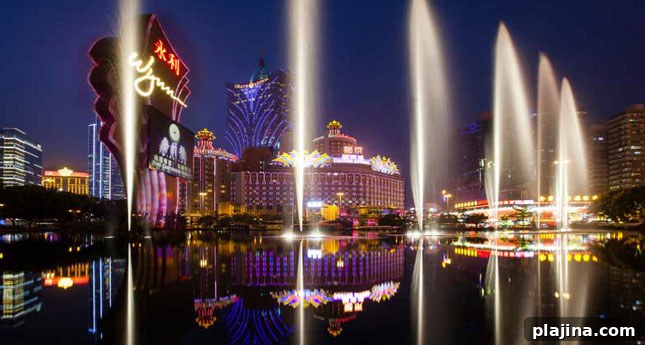
When I first visited Macau nearly 30 years ago, it was a quiet Portuguese enclave: pedicabs served as local taxis and a potholed road led from the ferry terminal into town. Most visitors were from Hong Kong, attracted by low-key casinos. Western travelers came for Macau’s relaxed pace, its distinctive mix of Chinese and Portuguese architecture, Macanese cuisine, inexpensive food and lodging, and the simple pleasure of sipping Portuguese wine on the veranda of the aging Bela Vista Hotel.
Today the city is almost unrecognizable. After the 1999 handover to China and the conversion of the Bela Vista into the Portuguese embassy, two major changes reshaped Macau’s future: the 2002 liberalization of the gaming industry, ending Stanley Ho’s 40-year monopoly, and mainland China’s 2003 Individual Visit Scheme, which allowed mainland residents to visit Hong Kong and Macau independently.
These shifts coincided with decades of aggressive land reclamation that more than doubled Macau’s size. The result is a skyline of high-rises, superhighways, large housing developments, expansive resorts, upscale shopping complexes, and some of the world’s largest casinos. The few remaining pedicabs have become quaint tourist attractions.
Now a global destination with a population of about 598,000 and a compact 11.5 square miles along the Pearl River Delta, Macau is the world’s preeminent gambling center. Annual visitor numbers rose from 7.5 million in 1999 to roughly 28 million today, over 60 percent from mainland China, drawn primarily by gaming and luxury shopping. Macau’s gaming revenue reached about $45 billion in 2013, roughly seven times that of Las Vegas, and the city’s 35 casinos surpass the combined revenue of all U.S. casinos.
Rapid growth brought challenges—congested streets laid out centuries ago, rising housing prices as demand for foreign workers increased, and pressure on small family businesses. Yet the transformation also delivered many benefits. Macau’s historic downtown, neglected decades ago, was restored and designated a UNESCO World Heritage site. The culinary scene expanded, luxury hotels now rival those in Hong Kong, and attractions and museums multiplied.
Beyond the casinos, Macau’s unique dual heritage—shaped by more than 450 years since the Portuguese established a port in 1557—makes it rich in culture. The city offers a rare fusion of Chinese and Portuguese influences across food, architecture and daily life. The historic core is a compact maze of narrow, hilly lanes, pastel colonial buildings, plazas shaded by banyan trees, temples, churches, traditional mansions and lively markets. Dining alone, from local Macanese specialties to international cuisine, justifies a trip to Macau.
Many of the approximately 185,000 Americans who visit Macau each year stay an average of 3.6 days, enough to see the city’s main sights. Begin with the Macao Museum, built into a hilltop fortress with panoramic views from its ramparts. Exhibits cover local history, traditions, crafts, festivals, architecture and cuisine, with recreated shops, costumes and photographs that bring earlier eras to life.
Right next door are the Ruins of St. Paul’s Church, Macau’s most photographed landmark. Built in 1602 and destroyed by fire and a typhoon in 1835, the remaining stone façade features ornate reliefs and statues blending Christian and Asian motifs.
These sites are part of the Historic Centre of Macao, a collection of 30 protected locations declared a World Heritage site in 2005. The area preserves some of the oldest Western structures on Chinese soil, including forts, squares, churches, temples, mansions and Asia’s oldest lighthouse, along with a library, cemetery, theater and garden.
From the St. Paul’s ruins, walk down the sweeping staircase to the black-and-white wavy pavement that leads to Senado Square, Macau’s main plaza. Nearby are the grand Leal Senado, 17th-century St. Dominic’s Church and Cathedral Square, a pleasant spot for people-watching—from schoolchildren to market-goers and worshippers.
Visit the Macau Business Tourism Centre on Senado Square for maps and guidance to the many nearby historic sites. Highlights include A-Ma Temple, which predates Portuguese arrival; the shaded Lilau Square; and the Protestant Cemetery. One standout is the Mandarin’s House, built in the late 19th century: an expansive compound of more than 60 rooms and courtyards that blends Chinese and European architectural styles.
Other notable attractions on the Macau Peninsula include the Handover Gifts Museum of Macao, which displays artworks presented from across China to mark the 1999 handover; the 1,083-foot Macau Tower, which offers adventurous activities such as mast climbs, exterior walks and bungee jumping; and the Red Market, an active food market in a 1936 Art Deco building. Shopping ranges from luxury brands to local specialties—gold jewelry along Avenida de Almeida Ribeiro, Portuguese wines and Chinese antiques and furniture reproductions near St. Paul’s.
To experience modern Macau’s spectacle, head to Cotai, a reclaimed strip that linked the islands of Colôane and Taipa and became the city’s main resort and entertainment zone. Cotai’s first casino opened in 2006, followed by The Venetian Macao-Resort-Hotel, which is twice the size of its Las Vegas counterpart and features thousands of rooms, outdoor pools, numerous restaurants, a Venice-style shopping complex with canals and the world’s largest casino floor.
Across the street, City of Dreams hosts multiple hotels, a large casino and a wide range of entertainment, including the House of Dancing Water spectacular with acrobats, divers and stunt performers. Sands Cotai Central adds family-oriented attractions like the DreamWorks Experience for younger visitors.
Foreign investors, including MGM Macau and Wynn Macau, own many major resorts on the peninsula, while iconic properties developed by Stanley Ho—such as the Grand Lisboa and Hotel Lisboa—remain striking for their dramatic architecture and art collections.
No visit is complete without sampling Macanese cuisine, a fusion born when Portuguese settlers and global traders introduced ingredients like chilies, cod, turmeric and cinnamon, which blended with Chinese staples such as ginger and soy sauce. Signature dishes include African chicken with piri-piri, spicy grilled shrimp, curry crab and minchi, a comforting mix of minced beef, fried potatoes, onion and garlic.
Alongside Macanese and Chinese restaurants, Macau offers French, Italian, Japanese, Korean, Thai and other international options. Colôane Village is a favored low-key dining spot, centered on the 1928 Chapel of St. Francis with outdoor cafés where you can relax over wine and seafood, enjoying a quieter side of Macau that preserves its historic spirit.
Macau Info to Go
Macau International Airport handles mainly regional flights from mainland China and other Asian cities such as Manila, Taipei, Bangkok and Singapore. Many international travelers connect via Hong Kong International Airport, where TurboJET hydrofoils reach the Macau Ferry Terminal in about one hour. In Hong Kong, TurboJETs also depart from Tsim Sha Tsui and Sheung Wan, while the Cotai Water Jet serves Taipa’s ferry terminal. Free shuttle buses from Macau Airport and both ferry terminals provide transfers to major hotels.