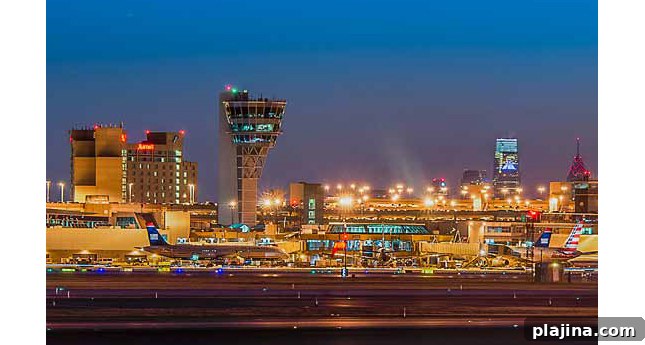
With self-deprecating humor, Mark Gale notes he has been part of the Philadelphia International Airport landscape for almost half of its 75 years as a commercial aviation center. Gale, the airport’s CEO since 2009, began his relationship with PHL as an intern in 1985. That three-decade span of first-hand experience gives him a distinctive perspective at the helm of one of the United States’ busiest airports.
“One of the most interesting changes for me goes back to when I started working at the airport in 1985. I worked on an extreme side of the airport in what we used to call the overseas terminal,” Gale recalled, describing the arriving international passenger’s first impression of Philadelphia at that time.
Imagine four old hangars, gutted and joined into a single structure tucked in a remote corner of the airport property. To reach the main terminal, arriving passengers walked roughly a quarter mile, carrying luggage, then boarded a bus for a 15-minute ride to the airport hub.
What a difference a decade—or three—can make.
Since 2000, PHL has invested $2 billion in capital improvements, including major airfield, terminal and cargo projects that have reshaped the airport, improved passenger experiences and strengthened its role in the global aviation network.
In April, PHL reached a settlement with surrounding townships and districts that cleared the way for enhancements outlined in a multibillion-dollar master development plan. Those planned improvements, to take place over the next 12 to 15 years, are intended to modernize the airport and increase capacity. Approved projects include a 1,500-foot runway extension to accommodate more long-haul flights, an automated inter-terminal people mover, a consolidated rental car facility and redesigned terminals to streamline ticketing, baggage processing and security screening.
Meanwhile, Philadelphia International Airport continues to adapt to the needs of 21st-century business and leisure travelers. Conveniently accessible by rail and road to downtown Philadelphia, the airport offers a range of traveler-focused services, including an expanded complimentary WiFi network, UPS access for business services and Minute Suites private retreats available to rent by the hour in 15-minute increments.
When asked to envision PHL in 2025, Gale emphasized that future development will follow a carefully planned timeline, a contrast to much of the airport’s earlier history when short-term fixes often took precedence over strategic planning.
“Time flies,” Gale said. “Whether we’re talking about the airport of 2025 or 2030, we’ll look back and say we have dramatically improved the experience at Philadelphia International Airport.”