
Some sports spread across the globe; others remain tied to a specific place. What determines whether a sport becomes international or stays local?
The Indonesian island of Sumbawa offers an illuminating contrast. In a single morning there I joined in the world’s most widely played sport and then watched a competition unlikely ever to go beyond its regional roots.
I arrived by cruise ship from Bali. The vessel anchored in a bay and passengers were ferried ashore in a small launch. I was among the first to disembark. While waiting for the rest of the group before our bus tour, I wandered over to a patch of wasteland where a group of boys were playing soccer. Whether by invitation or assumption, I was soon part of the game.
Soccer is played in virtually every country. The only necessity is a ball — I have even seen makeshift balls fashioned from plastic bags tied together with string. The rules are widely understood, the pitch can be almost anywhere, and the goals are easily improvised: piles of clothing, mounds of leaves, or, on Sumbawa, conveniently spaced palm trees.
When I boarded the bus I was breathless and sweaty, but I had also forged instant sporting bonds. The young players waved as our bus headed inland.
We arrived at a picturesque village of stilted wooden houses set among rice paddies. A large crowd from nearby settlements had gathered around one flooded field, and we tourists were introduced as guests of honor. “Now we will see buffalo racing,” our local guide announced. None of us had witnessed it before, and the sport seemed entirely new.
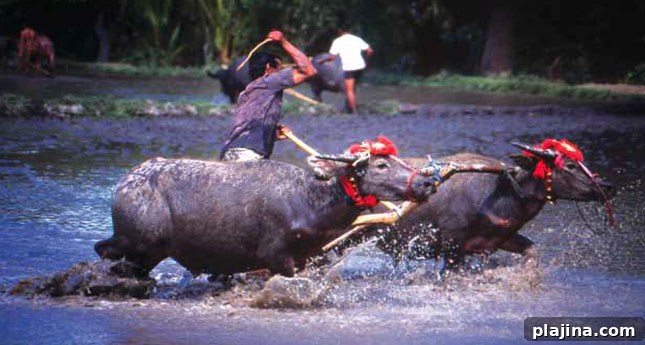
Sumbawan buffalo racing requires specific elements. First, water buffaloes. The arena is a waterlogged paddy. Pairs of buffaloes are harnessed to a rickety wooden sled, and a young farmer stands on that sled to steer and urge the animals forward as they charge through knee-deep mud.
There was, however, an unusual ceremonial detail. The village chief waded into the water carrying a two-foot wooden doll dressed in traditional costume and solemnly planted it at one end of the paddy. As the races unfolded it became clear that each team aimed to knock that doll over.
The races began amid cheering and splashing as sleds sent up curtains of water. Behind the crowd, villagers quietly placed bets on the outcome of each heat.
I spoke with a local who explained a practical side to the spectacle: the hooves and sleds churned and turned the mud, effectively preparing the paddy for the next planting.
Buffalo racing was a thrilling, unforgettable display. I enjoyed every minute but politely declined an offer to try it myself — I knew I would be leaving Sumbawa that afternoon.
On later journeys I encountered water buffaloes now and then, sometimes in paddies, and occasionally saw wooden plows similar to the racing sleds. I have even seen Indonesian dolls for sale in airport souvenir shops. Yet the only time all the required ingredients for buffalo racing came together was that single morning on Sumbawa.
As a sport, buffalo racing is rooted in local culture, practice and landscape; it occupies a geographic and cultural cul-de-sac. In contrast, a simple soccer ball can unlock play almost anywhere, offering a world of possibilities.