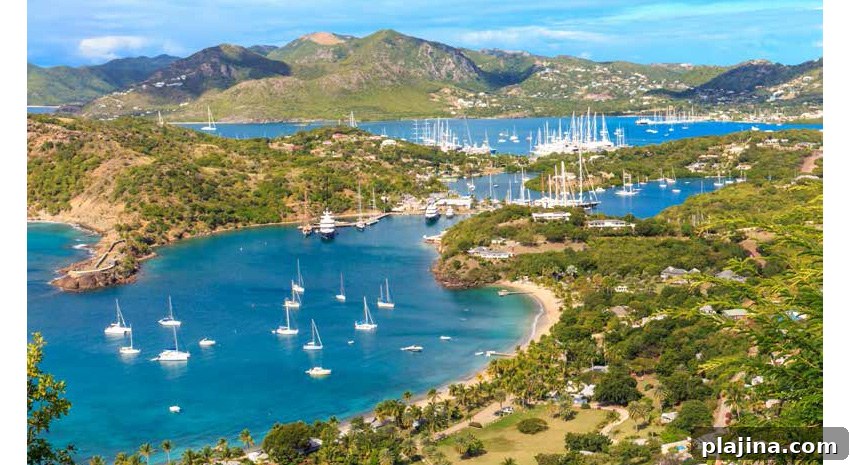
Beauty and tranquility have long drawn visitors, including celebrities, to Antigua. With a scalloped coastline dotted with sandy coves, the island prides itself on having a beach for every day of the year, many bordered by colorful reefs teeming with fish. Inland, rolling hills are cloaked in lush tropical vegetation, offering a verdant contrast to the shoreline.
Antigua, located in the Lesser Antilles of the Caribbean, has served as a regional hub for trade and transport for centuries. It continues to play that role today: international flights arrive at V.C. Bird International Airport, and many passengers transfer to smaller aircraft for short hops to neighboring islands.
Thirty miles north lies Barbuda, Antigua’s smaller partner in the nation of Antigua and Barbuda. Most of the country’s roughly 90,000 residents live on Antigua, home to the capital, St. John’s, numerous large resorts and the supporting infrastructure. Barbuda, by contrast, remains a low-lying coral island where seabirds outnumber people and the pace of life is noticeably slower.
Christopher Columbus sighted Antigua in 1493, but permanent European settlement did not begin until the British arrived in 1632. The colonists established sugar plantations and brought enslaved people from Africa; descendants of those enslaved communities today form the majority of the population.
Although Antigua and Barbuda became independent in 1981, British cultural and institutional influences persist. Vehicles are driven on the left, cricket is the dominant sport, and the country retains close ties to the United Kingdom.
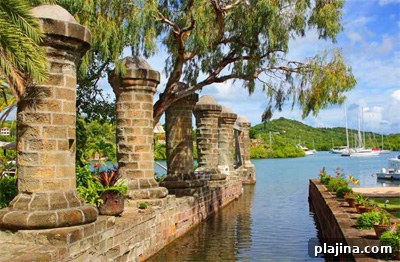
Nelson’s Dockyard © ALFOTOKUNST | DREAMSTIME.COM
One of the island’s most evocative historical sites is Nelson’s Dockyard, a well-preserved 18th-century naval yard on English Harbour that has earned UNESCO World Heritage recognition. From here, Horatio Nelson and other naval officers once patrolled the Caribbean, overseeing shipping lanes and protecting British interests. Today, the dockyard’s restored buildings, cobbled quayside and maritime atmosphere invite visitors to imagine the days of tall ships and bustling naval activity. While the fleet has long since sailed, English Harbour remains a sheltered anchorage popular with sailing yachts.
St. John’s, on the island’s northeast coast, predates the dockyard but much of its early architecture was lost to an 1843 earthquake. The modern city is an attractive jumble of mostly wooden buildings painted in soft pastels. Cruise ships that visit can dwarf St. John’s modest skyline, but the city retains notable landmarks.
Dominating the center of St. John’s are the twin towers of St. John’s Anglican Cathedral, which has stood since the 18th century. Severely damaged in the 1843 quake, the cathedral was rebuilt with an internal pine structure that gives the interior timberwork the feel of a ship’s hull. The cathedral remains an important part of local life, though it occasionally undergoes restoration work.
Nearby, the Antigua Recreation Ground reflects the island’s passion for cricket. Although many international fixtures have shifted to the newer Sir Vivian Richards Stadium since 2007, the Recreation Ground continues to occupy a special place in West Indian cricket history.
Antigua’s principal attraction is its beaches. The Five Islands peninsula west of St. John’s showcases the island’s most idyllic shoreline: soft white sand, sheltered turquoise bays and reefs visible beneath crystal-clear waters. Perched on a headland, the ruins of Fort Barrington offer a commanding viewpoint over this scenic stretch.

A pink-sand beach in Barbuda © ALEXANDER SHALAMOV | DREAMSTIME.COM
For those seeking near-total solitude, Barbuda delivers the ultimate Robinson Crusoe experience. The island’s powdery beaches—sometimes tinged pink—stretch for miles, and its clear, warm waters invite long, empty walks along the shoreline. Barbuda’s remoteness and low development preserve a sense of pristine wilderness.
Nature lovers should not miss the Frigate Bird Sanctuary on Barbuda, where thousands of frigate birds nest among mangroves in and around Codrington Lagoon. The males display by inflating bright red throat pouches to attract mates, creating a striking and memorable spectacle.
Over the years Antigua and Barbuda have attracted a wide range of visitors, drawn by calm waters, sheltered anchorages and a tranquil island lifestyle. The islands provide a peaceful escape, whether your interest is history, sailing, birdwatching or simply relaxing on some of the Caribbean’s finest beaches.
Antigua and Barbuda Info to Go
International flights arrive at V.C. Bird International Airport on Antigua’s northern end. Many resorts provide transfers from the airport. If you rent a car, remember that driving is on the left. Montserrat Airways operates frequent short flights from V.C. Bird to Barbuda’s Codrington Airport (about 20 minutes). A ferry service, Barbuda Express, also crosses the channel in about 90 minutes, typically departing Antigua at 9 a.m. (noon on Sundays); there is no service on Mondays or Wednesdays. U.S. visitors must travel with a valid passport, an onward or return ticket and confirmation of accommodation.
Where to Stay in Antigua and Barbuda
COCO POINT LODGE This relaxed, small resort on the southern tip of Barbuda sits on its own peninsula and offers access to 2.5 miles of pristine white sand. Barbuda $$$
CURTAIN BLUFF Located on Antigua’s southwest coast, this all-inclusive resort is ideal for active travelers, with watersports, excellent tennis facilities and two beaches. Old Road, Antigua $$$$
JUMBY BAY, A ROSEWOOD RESORT Set on a private 300-acre island two miles off Antigua’s north coast, this exclusive resort is reachable only by a short boat ride and offers bicycles to explore the island. Jumby Bay Island, Antigua $$$$
Restaurants in Antigua and Barbuda
LE BISTRO Though described as French, this refined restaurant presents a diverse menu that includes Japanese, Indian and Italian influences—sashimi is a recommended choice. Hodges Bay, St. John’s, Antigua $$$
HEMINGWAYS CARIBBEAN CAFE Set in a traditional gingerbread-style house in St. John’s, this spot serves Creole dishes and tropical cocktails in a relaxed atmosphere. Lower St. Mary’s Street, St. John’s, Antigua $$
IT’S A BIT FISHY A straightforward local favorite for fresh Caribbean seafood grilled or steamed; usually open evenings, but lunchtime service can be arranged. River Road, Codrington, Barbuda $$