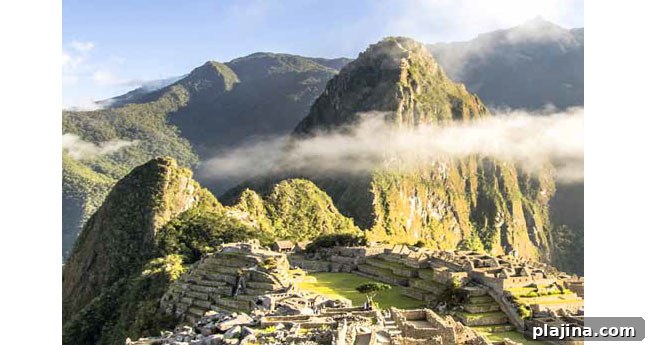
We rose while it was still dark, dressing quickly inside the tent before stepping out into crisp mountain air and sipping coca tea as we checked our flashlights. Like pilgrims, we followed our guide in single file, climbing steadily until we reached the Gate of the Sun. As dawn painted the sky pink and orange, the object of our journey appeared: the Inca stone complex of Machu Picchu.
Long before Machu Picchu in Peru was named one of the New Seven Wonders of the World, it had already earned a spot on many travelers’ bucket lists. The view my wife and I enjoyed that morning — Huayna Picchu looming behind terraced buildings cascading down a steep slope — has been one of the most iconic travel images for decades. For anyone traveling to Lima on business, adding a few days to visit Machu Picchu often feels inevitable.
To prevent damage from excessive visitation, authorities cap daily admissions at 2,500 visitors. Travelers not on an organized tour should reserve tickets in advance through the official Machu Picchu ticket site to ensure entry.
Hiram Bingham introduced Machu Picchu to the wider world in 1911 after local farmer Melchor Arteaga guided him to the site. Bingham’s photographs and archaeological work brought global attention to this lost Inca city, which until then had been known mainly to local farmers. Over the following century, theories about the complex’s purpose varied widely. Today the prevailing view is that Machu Picchu was likely a country estate for the Inca emperor Pachacuti rather than a military fortress or cult site. Because the site remained unknown to the Spanish conquerors, it was never dismantled for building materials used elsewhere.
Part of Machu Picchu’s power is its isolation: an improbable settlement perched on a mountaintop ridge, surrounded by higher peaks. At times clouds sweep in and transform the landscape into an eerie scene seemingly made for the ghosts of ancient warriors.
Most visitors are struck by the advanced craftsmanship on display. Without beasts of burden, the Incas quarried and moved massive stones to build palaces and terraces. The blocks are so precisely cut and fitted that a credit card won’t slip between them. Remarkably, this extraordinary complex was likely built, used and abandoned within roughly a century.
On my first visit, after finishing business in Lima my wife joined me for a four-day hike on the famed Inca Trail. We ate sitting on folding chairs and slept in tents at night, while porters carried, set up, and dismantled the camp and cooked our meals on propane stoves. We each carried a small daypack with camera gear, water and extra layers.
The scenery along the trail is spectacular, and the slow, effortful approach — the same route the Incas once used — reinforces the sense of discovery. Along the way are additional stone complexes accessible only by foot; several of these would be headline attractions in other countries.
The Salkantay Trail © Tim Leffel
Years later, when business brought us back to Lima, we returned to Machu Picchu with more concern for comfort, choosing an alternate route: the Salkantay Trail with Mountain Lodges of Peru. This option places comfortable lodges roughly a day’s hike apart and uses mules instead of porters. The scenery is different and dramatic — snowy peaks, a glacial lake, then cloud forest and humid jungle as the route descends.
The lodges felt indulgent compared with Inca Trail camping: fresh meals from real kitchens, fireplaces and comfortable sofas in common rooms, a heated foyer for drying boots, hot showers with quality toiletries, and real mattresses in heated rooms.
At Machu Picchu we took a guided tour of the citadel, visiting the Hitching Post of the Sun, the Temple of the Sun and the Room of the Three Windows. Having seen the site before, I noticed details I had missed on my first trip, while still enjoying the surrounding scenery.
After a morning exploring the ruins, we enjoyed lunch at the restaurant at Machu Picchu Sanctuary Lodge, sampling elevated versions of traditional Andean dishes. In conversations with guides and chefs we learned — repeatedly and with good humor — about the astonishing variety of Peruvian potatoes. Depending on your source, there are claims of dozens to hundreds of varieties; regardless of the exact number, the diversity is real, including potatoes that are purple, orange or red. We also ate quinoa, drank Pisco sours and savored desserts made with Peruvian chocolate, choosing local cuisine over international dishes until we returned home.
Descending by bus along the zigzag dirt road to Aguas Calientes — the town below the ruins — it was easy to imagine how Machu Picchu remained hidden for so long. Reaching the mountaintop on foot before the arrival of the railway would have been a grueling undertaking. Aguas Calientes sits on the only flat stretch in a narrow gorge by the Vilcanota River, and from parts of town the cleared ruins are now visible across the valley.
Aguas Calientes © Tim Leffel
Hiram Bingham’s expedition from Cusco took seven days with several mules; today travelers can reach the area in a matter of hours. The luxury Orient-Express Hiram Bingham train offers an elegant journey between Cusco and Machu Picchu, with vintage-style dining cars, polished wood interiors and attentive, bilingual staff as mountain scenery passes by outside curved glass roofs.
After our trek we spent an extra night in Aguas Calientes to recuperate rather than revisit the ruins immediately. We relaxed at the local hot springs and indulged in massages at the Inkaterra Machu Picchu Pueblo Hotel, then wandered the hotel grounds admiring orchids and watching hummingbirds and butterflies among the flowers.
Machu Picchu is accessible enough to include at the end of a business trip to Lima. Several airlines fly daily between Lima and Cusco, and trains from Cusco reach Machu Picchu in about three hours. Train tickets and entrance permits sell out quickly, so it’s wise to book both well in advance. Keep in mind that Lima is at sea level while Cusco sits higher than the Rocky Mountains; allow time to acclimate if possible. The region offers excellent hotels and resorts, making a longer stay rewarding.
For a place as awe-inspiring and distinctive as Machu Picchu, set against the dramatic Andes, it feels right to linger. We spent extra time in the Sacred Valley town of Urubamba before taking the train back to Cusco, leaving with hundreds of photographs and lasting memories.
Machu Picchu Info to Go
Daily flights connect Lima (LIM) and Cusco (CUZ). PeruRail trains travel between Cusco and Machu Picchu in about three hours; because train seats sell out fast, reserve early. Purchase Machu Picchu entrance tickets in advance through the official ticket website. The bus from Aguas Calientes up to Machu Picchu takes about 20 minutes on a winding mountainside road. The Orient-Express Hiram Bingham train offers a luxurious travel option and can include the bus transfer and entrance ticket.
Where to Stay in Machu Picchu
Inkaterra Machu Picchu Pueblo Hotel — Nestled on 12 acres between river and mountains, this nature-focused luxury property provides a peaceful retreat from the bustle of town. Aguas Calientes $$$$
Machu Picchu Sanctuary Lodge — Located at the top of the mountain next to the ruins, this refined Orient-Express lodge offers the closest possible access to Machu Picchu. Next to Machu Picchu $$$$
Sumaq Machu Picchu Hotel — A traditional-style hotel with pleasant views and warm service, located in Aguas Calientes. Avenida Hermanos Ayar Mz.1 Lote 3, Aguas Calientes $$$$
Restaurants in Machu Picchu
Indio Feliz — One of the town’s most acclaimed restaurants, combining French technique and Peruvian flavors in a romantic setting. Lloque Yupanqui St. 103, Aguas Calientes $$
Qunuq Restaurant — Located at the Sumaq Machu Picchu Hotel, this gourmet restaurant showcases high-level fusion cuisine using top Peruvian ingredients. Avenida Hermanos Ayar Mz. 1 Lote 3, Aguas Calientes $$$$
Tampu Restaurant — Inside the Machu Picchu Sanctuary Lodge, this spot offers excellent lunches and dinners with mountain views through glass walls — an ideal stop after touring the ruins. Machu Picchu Sanctuary Lodge, next to Machu Picchu $$$