
Chances are you have already interacted with Bangalore over the phone. When U.S. companies outsourced large volumes of customer-support work, India’s third-largest city emerged as a major hub. Your voice has very likely been routed to an agent working from Bangalore.
In recent years, some call centers in Bangalore have adopted Americanized names for agents and hired accent coaches to soften regional inflections, often aiming for a West Coast sound. These efforts help conceal the fact that the call centers are located in Bangalore, even while the city itself increasingly represents the confident, modern face of India and is growing as a destination for meetings, incentives, conferences and exhibitions (MICE).
As is common in India, identity and change can be complex. Over the last decade Bangalore gained global recognition that many cities would envy. Whether admired or criticized, the proliferation of call centers helped put the city on the world map. Despite that global profile, regional authorities have officially restored the traditional name: Bengaluru.
The name Bengaluru sits uneasily beside the city’s gleaming high-rises and booming information-technology sector that earned it the title India’s Silicon Valley. The older name evokes the city’s rural roots—literally translated, it is said to mean “town of boiled beans”—while the modern skyline reflects a forward-looking urban center.
Many local businesses and tourism organizations continue to use the familiar name, including the Bangalore International Exhibition Centre (BIEC), which remains one of India’s premier venues for conferences and exhibitions.
Located roughly 12 miles northwest of the city center—an airport-traffic-dependent drive of 30–60 minutes—BIEC occupies 34 acres of landscaped grounds and offers three exhibition halls totaling 430,500 square feet. The center hosts a wide range of events, from electronics and biotechnology trade fairs to large public exhibitions such as the Space Expo.
Reflecting Bangalore’s high-tech ambitions, BIEC emphasizes modern infrastructure and sustainability. It was among India’s first conference venues to earn LEED certification and incorporates features such as rainwater harvesting and ozone-friendly air conditioning. The center’s energy-efficient food hall combines international brands with local cuisine.
North of downtown and close to the airport corridor, the Royal Orchid Resort & Conference Centre provides flexible meeting and banqueting spaces, as well as The Dome, a theater-style venue seating up to 370 delegates. The resort has 54 well-appointed guestrooms, including cottage suites with separate living and dining areas; note that WiFi access there may be charged separately.
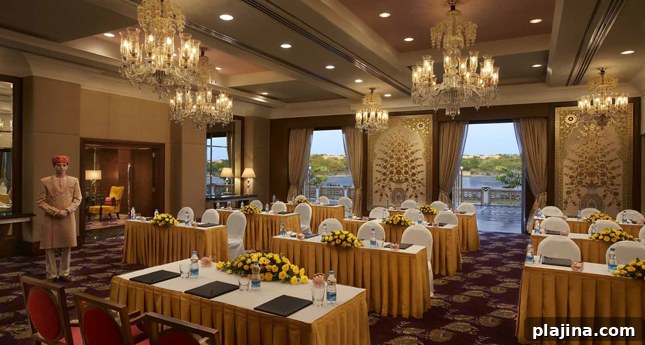
Meeting room at The Oberoi, Bangalore © The Oberoi, Bangalore
Downtown, meeting planners will find numerous high-end hotel options. The Oberoi, Bangalore, located in the heart of the financial and shopping districts, offers 160 guestrooms and a guest technology platform that lets visitors customize lighting, air-conditioning and entertainment via an in-room tablet.
The Oberoi provides three meeting rooms serving up to 70 participants, equipped for teleconferencing and supported by experienced staff. For more informal gatherings, the colonial-style veranda of the hotel’s Polo Club offers a pleasant setting.
Along Mahatma Gandhi (MG) Road, Hyatt Bangalore MG Road has smaller boardrooms suited to executive meetings and seminars. Two boardrooms each accommodate up to 10 people, while a larger banqueting room can be arranged for business functions or themed events with catering for roughly 180 guests.
The modern centerpiece of downtown Bangalore is UB City, a mixed-use development of high towers overlooking Cubbon Park. The district’s flagship hotel, JW Marriott Bengaluru, has 297 rooms and nine meeting spaces, including a pillar-free ballroom that can seat up to 500 guests. Its proximity to Cubbon Park makes it an attractive choice for delegates seeking a green respite amid the urban environment.
To the east, Whitefield is one of Bangalore’s major tech precincts, located about 11 miles from downtown and home to the International Tech Park (ITPB). At the park’s entrance, Vivanta by Taj—Whitefield provides 170 guestrooms and 29 suites and includes a theater-style auditorium seating around 350 delegates. Be aware that multiple Vivanta by Taj properties exist across the city, so confirm which location you need when arranging transport.
Another important corporate cluster is the Embassy Golf Links Business Park, adjacent to the prestigious Karnataka Golf Course. The Hilton Bangalore Embassy GolfLinks, convenient to both the business park and the course, offers 247 rooms with kitchenettes and a selection of meeting rooms for groups up to about 80 people.
While many modern hotels in Bangalore feel international in design and service, some properties emphasize Indian heritage. The Leela Palace Bangalore draws inspiration from the Palace of Mysore and conveys traditional opulence. Its conference spaces are lavish and versatile, accommodating gatherings from intimate board meetings of 18 up to grand events for 550 guests.
Bangalore is also an excellent place to experience India’s passion for cricket. From April to June, the Indian Premier League captures the nation’s attention, and the local Royal Challengers franchise fields several high-profile international players. A night match at the 36,000-capacity M. Chinnaswamy Stadium is a memorable way to cap off a business trip, offering a vivid taste of local culture alongside the city’s business facilities.