
There is a fine line between order and chaos. At the Korean Folk Village, an hour’s drive south of downtown Seoul, thirty preschool children were kept in a neat double line by holding a long rope. The line held until it snagged on a wooden see-saw and snapped. Suddenly freed, the children scattered in every direction, chased by their harried teachers.
We watched with sympathy. Once the children were gathered again, calm returned and we continued our stroll through this carefully reconstructed traditional village.
The modern bustle of the capital felt far away. Seoul embodies South Korea’s rapid transformation and constant reinvention. In just a few decades the country embraced Western technologies, lifestyles and branding while forging a distinct contemporary identity.
Beyond the skyscrapers and bright billboards, however, a rich, long-standing culture persists. At the Folk Village that heritage is displayed across 260 buildings through regular dance performances, cultural demonstrations and hands-on craft workshops.
A memorable experience for older children—and adventurous adults—is the traditional Korean see-saw. Two participants jump in turn on opposite ends, launching each other two or three feet into the air. Folklore says the see-saw once allowed women to leap high enough to glimpse over prison walls when their husbands were held captive.
After seeing Korea’s past interpreted through a modern lens at the Folk Village, a short drive brings you to Everland, the country’s answer to large-scale Western amusement parks. Everland offers thrilling roller coasters, themed European and American zones, a drive-through zoo, a speedway and a vast water park, Caribbean Bay. Many attractions are outdoors, so visitors should plan around Korea’s extremes: stifling summers and bitter winters.
Weather is less of a concern at Lotte World, another major theme park located on the south bank of the Han River near the Olympic Stadium. Most rides, parades and attractions are indoors. The complex also includes cinemas, a monorail, shopping malls, a skating rink and an attractively curated folk museum. Lotte World is busy year-round and, like Everland, ranks among the world’s leading theme parks.
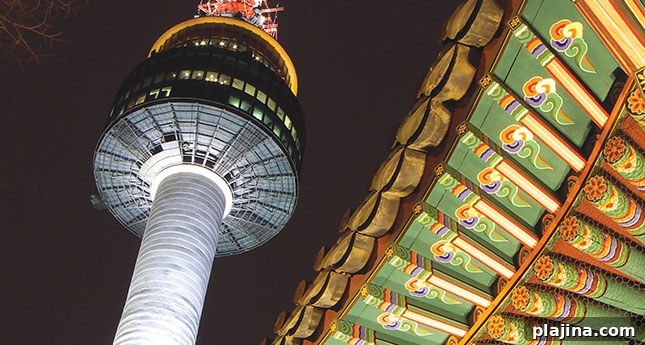
With more than 24 million residents in its metropolitan area, Seoul is second only to Tokyo in population. The scale of the city becomes clear from the top of Seoul Tower, a 777-foot communications structure on Mount Namsan.
To reach the tower from downtown, a cable car rises above crowded streets and wooded slopes. Mount Namsan forms a natural divide between downtown and the southern neighborhoods, though highway tunnels make the separation more psychological than physical.
From the tower’s observation deck, even through a veil of haze, you can see how mountains to the north and the winding Han River to the south have shaped Seoul’s growth. The city spreads into a mosaic of distinct districts, each with its own character.
The Seoul City Tour Bus is a convenient way to sample many of those neighborhoods. Two main routes cover the city’s major palaces, museums and cultural sites as well as bustling markets and shopping districts. A day pass allows hop-on, hop-off flexibility.
Despite its rapid modernization, Seoul preserves significant historical sites, including several royal palaces. Gyeongbokgung, the Palace of Shining Happiness, is the most impressive and sits within leafy grounds just north of the Central Business District.
The National Museum of Korea was once on the palace grounds but moved in 2005 to a modern building in Yongsan after the surrounding land was returned to the city by the U.S. Army. Yongsan remains a hub of cultural sites and transportation.
Nearby Itaewon has long been a favored hangout for U.S. soldiers and foreign visitors, so English is more commonly spoken there than in many other districts. By day you can browse over a thousand shops and hundreds of sidewalk stalls selling souvenirs, clothing and electronics at negotiable prices. After dark, Itaewon becomes a neon-lit nightlife district of clubs and bars.
Myeong-dong offers a different shopping vibe, catering to fashion-conscious young people and serving as a focal point of the Korean Wave—South Korea’s global cultural export of music, television and fashion. Here you can discover the latest trends and find local music releases from major pop and hip-hop artists.
Popular music is embedded in everyday life, and the city is dotted with noraebang—private karaoke rooms—many of which carry extensive selections of Western and Korean hits.
Korean film and television have also gained international popularity. Major cinemas screen local releases with subtitles, and DVD bangs let visitors watch new releases on large, high-definition screens in private rooms; hotel concierges can recommend family-friendly options.
Despite its energy and modernity, Seoul lies only about 34 miles from one of the world’s most tense borders. A visit to the Demilitarized Zone (DMZ) is an important, sobering day trip. Tours, such as those organized by USO Seoul, require advance booking.
On a cold autumn morning we boarded a USO bus at Camp Kim near Yongsan and drove through the city. Traffic thinned as we neared the border, until ours was the only vehicle on the road. Panmunjom and its surroundings are heavily fortified with barbed wire and military installations. After a formal briefing, we approached the border where North Korean soldiers observed us expressionlessly.
Inside a prefabricated building we circled a negotiation table split by the actual border line—one step across took us into North Korea, and a few steps back returned us to South Korea. It is a stark reminder of the fragile line between oppression and freedom.
Info To Go
Most travelers arrive at Incheon International Airport (ICN), located about 43 miles west of downtown on reclaimed land. Several shuttle services connect the airport with central hotels; fares vary by operator and seat class.
Lodging
Fraser Suites Seoul
Serviced apartments in Insadong ideal for families; babysitting available. 272 Nakwon-dong, tel 82 2 6262 8888.
Grand Hyatt Seoul
Set in attractive hillside grounds near Itaewon, offering contemporary rooms and easy access to shopping. 747-7 Hannam 2-dong, tel 82 2 797 1234.
Lotte Hotel Seoul
A super-deluxe hotel adjacent to Lotte Department Store, close to City Hall in the heart of downtown. 1 Sogongdong, tel 82 2 771 1000.
Dining
Gecko’s Garden
Mediterranean fare near Itaewon, convenient for lunch during shopping. 116-6 Itaewondong, tel 82 2 790 0540.
Gorilla in the Kitchen
Owned by actor Bae Yong-joon, this trendy spot serves healthy international dishes with portion choices labeled “human” and “gorilla.” 650 Sinsa-dong, tel 82 2 3442 1688.
Seokparang
Housed in a historic royal mansion, Seokparang specializes in traditional multi-course set menus. 125 Hongji-dong, tel 82 2 395 2500.