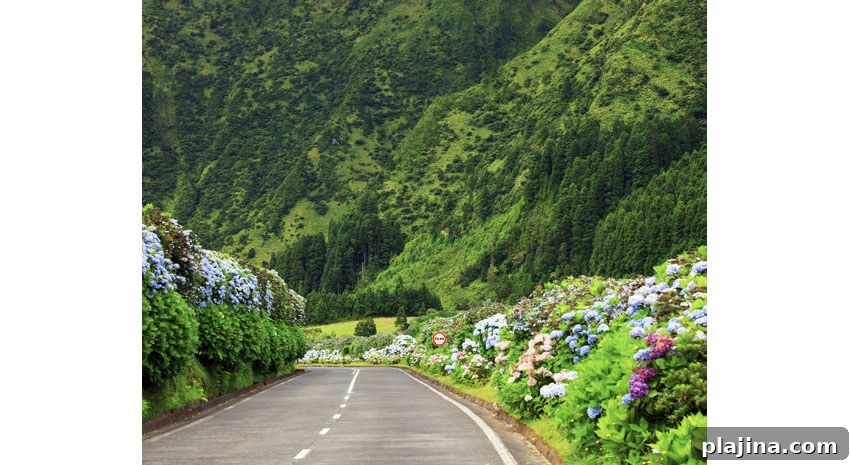
“I always say that when you drive through the highways of São Miguel, it’s like driving through a garden,” said Rui Medeiros, my guide from Sagres Vacations, a bespoke tour operator to Portugal. Rui was leading our group through the São Miguel portion of my trip to the Azores. On this leg of my Atlantic journey, he drove us to Sete Cidades, one of the island’s most otherworldly destinations. Along the way, bouquets of hydrangeas—blue, pink and purple—still bloomed in mid-November, flanking the road. Even Rui was surprised by how vibrant they remained despite winter looming weeks away. In the Azores, gardens flourish long after you might expect.
The Azores archipelago is nine volcanic islands in the middle of the Atlantic, roughly 900 miles from mainland Portugal, which first colonized the islands in the 15th century. Yet if you’ve visited the Continental mainland, the Azores will feel worlds apart: the landscape, the climate and the pace seem to belong to another realm. Sete Cidades makes that difference clear. This three-mile-wide caldera is impossibly lush and dramatic, wild in a welcoming way, and wrapped in a local legend that explains why its twin lakes bear two different colors.
Local lore says the lakes were formed by the tears of star-crossed lovers: an Azorean princess, forbidden to marry a young shepherd, wept and created the green lake—because of her green eyes—while the shepherd’s blue eyes produced the blue lake. It’s a romantic story for a place that looks rugged more than tender, but from a roadside viewpoint at the top of the caldera—where I watched the two lakes sit between verdant cliffs and scattered hillside villages, the scene softened by thin fog—I wanted to believe it. The nearer lake mirrored the sky, showing a pale blue, while the farther lake appeared darker and greener, more secretive. It felt fitting that such a striking landscape should have a stirring origin story.
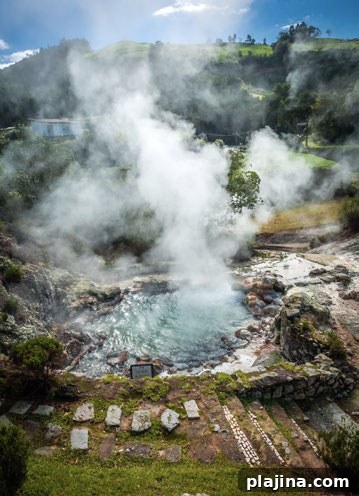
Geothermal hot water hole in Furnas © PAOP | DREAMSTIME.COM
Drama is everywhere in the Azores. São Miguel—the archipelago’s largest island, often called the Green Island—offers rugged, surprising scenery that rewards exploration on foot. Furnas, famous for its sulfurous hot springs, provides striking panoramas from viewpoints like Pico do Ferro. Rui offered to drive us comfortably down to the village for lunch, but I chose to hike and earn my meal. The morning rain left the mile-long trail muddy but manageable; under a canopy of ferns and cheesewood, the path descended steadily. The lake revealed itself from different angles, small farms dotted with black-and-white cows came into view, and the best part was feeling the soil beneath my boots and being immersed in lush foliage.
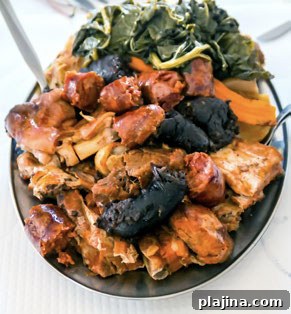
Cozido das furnas, a local Azorean meal, is cooked underground by volcanic heat on São Miguel. © SERGEY MAYOROV | DREAMSTIME.COM
Before I reached the village, the scent of volcanic heat announced I was near. The valley floor is alive with thermal activity: tourists gather to watch the ground bubble and locals retrieve pots of food cooked by the earth. Cozido das Furnas is a culinary icon here—stews of meats and vegetables are packed into pots, buried in the hot ground and slow-cooked by geothermal heat for hours. During the day, restaurants return to collect their buried pots. If you want to taste a true local specialty, nearly every eatery in the area offers cozido. The hearty stew—often including beef, chicken, pork, blood sausage and potatoes—felt like the perfect reward after my 45-minute hike.
If São Miguel is the Green Island, Pico is often called the Black Island for its volcanic rock that defines both coast and architecture. At the center of Pico island rises Mount Pico, Portugal’s highest peak and a coveted climb. The 3,700-foot ascent typically fills a full day; many hikers begin in the early morning hours to reach the summit by sunrise, while others time their climbs for sunset and camp overnight. Rain and fog during my two-day stay made the mountain unsafe to climb, but Pico offers much more besides the summit.
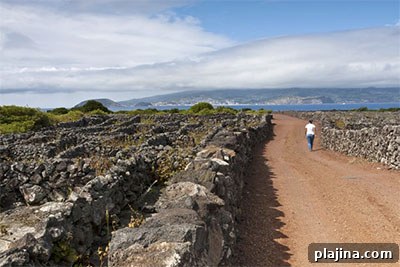
Vineyard stone corrals on Pico, built to protect the grapes from wind and sea salt, earned UNESCO World Heritage status © JAIME DEBRUM | DREAMSTIME.COM
Pico’s maritime past is on display at Museu dos Baleeiros in Lajes, which documents the island’s whaling history with exhibits that include traditional whaling boats, photographs of local figures who shaped the industry and carved whale bone artifacts. My guide Evelina Garcia, who grew up on Pico, pointed out faces in the photographs she remembered from childhood. Today, vineyards define another important chapter of Pico’s identity. A 2,440-acre vineyard landscape earned UNESCO World Heritage status because of the distinctive way grapes are cultivated: tiny plots enclosed by semicircular walls of black volcanic stone protect vines from wind and salt spray. Walking through those low-walled vineyards, surrounded by dark rock and sea, is unlike any wine-region experience you’ll find elsewhere.
For wine tasting, book ahead at Adega A Buraca, a family-run winery that also serves as a living museum of local tools and traditions. The family produces fortified Verdelho—comparable to Port—and a crisp, flavorful white called Cacarita, which I found particularly memorable. They also make schnapps-style liqueurs from island-grown fruits and vegetables, but the wines make excellent souvenirs and a fine way to remember the Azores’ unique terroir.
Azores Info to Go
Direct flights to São Miguel from the United States are available from Boston on Azores Airlines, with a flight time of about four hours; the airline recently upgraded cabins and added Wi-Fi. Seasonal and expanding service from other U.S. cities has increased options for visitors. Connections through mainland Portugal—cities like Lisbon and Porto—are also convenient on national carriers. From Ponta Delgada airport, taxis to many hotels start at roughly €10, with fares varying by time of day and distance.
Where to Stay in the Azores
OCEAN BREEZE Modest but charming rentals with superb ocean views, these accommodations display stacked volcanic stone that reflects Pico’s traditional architecture. Cais de Mourato, Madalena, Pico $$
SANTA BÁRBARA ECOBEACH RESORT Set on São Miguel’s north side near high-quality surf spots, this stylish resort consists of 14 low-profile villas and blends natural surroundings with thoughtful design. Estrada Regional nº1, 1º Morro de Baixo, Ribeira Grande, São Miguel $$
WHITE EXCLUSIVE SUITES AND VILLAS A small cliffside property inspired by Cycladic minimalism, offering nine suites and one villa on São Miguel’s southern coast—an intimate choice for couples. Rua Rocha Quebrada 10, Lagoa, São Miguel $$$$
Restaurants in the Azores
CALÇADA DO CAIS A dependable menu of Portuguese favorites—from garlicky poultry sausages and crusted cod with herb butter to steaks and risottos—makes this a versatile choice for many palates. Rua dos Mercadores 27–31, Ponta Delgada, São Miguel $$
O ANCORADOURO Known for a cataplana of local seafood, including limpets, paired with volcanic white wines from Pico, this spot serves some of the region’s most satisfying seafood dishes. Estrada Longitudinal, Areia Larga, Madalena, Pico $$
TASQUINHA VIEIRA In downtown Ponta Delgada, this modern restaurant from chef-owner Joel Vieira presents elegant, globally influenced interpretations of Azorean ingredients in a stylish setting. Rua António Joaquim Nunes da Silva 21, Ponta Delgada, São Miguel $$$