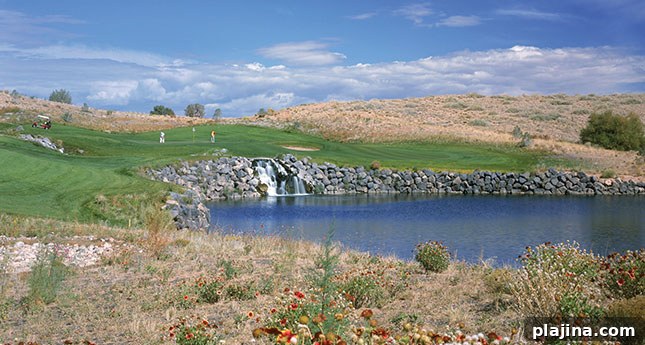
Twin Warriors Golf Club, set in the high desert just outside Albuquerque, New Mexico, winds amid 20 ancient Native American cultural sites and showcases rolling grassy knolls and ridges dotted with juniper and piñon pine. Dry washes, or arroyos, trace the slopes of the sacred butte known as Tuyuna (Snakehead), creating striking views of the Sandia Mountains and a dramatic desert golf setting.
Part of the Hyatt Regency Tamaya Resort & Spa, Twin Warriors ranks among Golf Digest’s top 75 resort courses in the United States. The resort and course sit on the Santa Ana Pueblo, 20 minutes from Albuquerque and about 40 minutes from Santa Fe, with convenient transportation between the resort and course. Dining at the Prairie Star Restaurant is worth recommending; the mixed-grill presentation is memorable and the local green-chili mashed potatoes are a spicy local specialty.
Opened in 2001 and designed by Gary Panks, the course was routed to respect the natural terrain and to avoid disturbing ancient tribal sites. The layout has hosted notable events including the Trans National, the New Mexico Open and the 2003 PGA of America’s PGA Professional National Championship. The routing emphasizes native desert character, strategic bunkering and elevation changes that take full advantage of the high-desert landscape.
Hole 1 (563 yards, par 5)
The opening hole looks intimidating from the tee, but the fairways are more generous than they appear. The hole features a double landing area separated by native desert growth. Most players can safely use a driver off the tee, but keeping the ball straight is crucial. From the landing area, the second shot needs to avoid bunkers on the right before a relatively short pitch to the green. If you keep the ball in play, the opening hole is a fair introduction to the course’s strategic demands.
Hole 3 (502 yards, par 4)
At more than 500 yards, the third plays almost like a par 5. The tee shot must carry a native area to find a narrow fairway flanked by two bunkers on the left. The approach requires clearing another area of native growth to an elevated green, making club selection and distance control especially important on this long, testing hole.
Hole 7 (489 yards, par 4)
The seventh requires avoiding three bunkers along the right side of the fairway; big hitters will find a large landing zone from which to attack the amphitheater-style green below. The green slopes left toward a dry wash that catches many errant shots, often forcing a delicate chip back toward the putting surface. The slope and wash create a challenging finishing sequence to the hole.
Hole 9 (208 yards, par 3)
This par 3 is a standout for its visual appeal and subtle complexity. The tee and green sit nearly level, with a depression between them. Panks used a Redan-style green that slopes downward toward the entrance, and a significant bunker front-left demands an accurate carry onto the green with minimal reliance on roll. A smaller bunker guards the right, leaving little room for error on this scenic short hole.
Hole 10 (483 yards, par 4)
Starting the back nine, the tenth remains formidable and requires a strong tee shot. While the high-desert views and vivid colors of the landscape invite a moment’s appreciation, focus is required: the approach to an elevated green must carry a wash and native area. If you miss, favor left-of-green bail-out options, where more fairway space makes recovery easier than flirting with hazards on the right.
Hole 12 (584 yards, par 5)
This long dogleg left can be deceptively tricky near the green. From the tee aim for the corner of the turn and avoid sandy washes that line both sides of the fairway. The second shot is typically a fairway wood, laying up short of a wash that cuts across in front of the green. Approach shots that misjudge the wash or run out of turf often leave difficult recovery lies, so precise placement into the landing areas is essential to save par or better.
Hole 14 (420 yards, par 4)
Holes 14 through 18 run along land that the Pueblo of Santa Ana values, and ancient sites are visible from the cart path, reminding players of the location’s cultural significance. The 14th plays downhill to a narrow landing area before rising to an amphitheater green that sits at the base of Snakehead Mountain, providing both a strategic challenge and a scenic backdrop.
Hole 18 (488 yards, par 4)
The finishing hole offers both challenge and atmosphere. Turning away from Snakehead, the hole leads back toward the clubhouse while passing a centuries-old horse corral preserved by the tribe near a lone tree—an evocative reminder of the land’s history. A long tee shot is required as the hole climbs to the green. Aggressive lines can reach the putting surface, rewarding bold play, but careful consideration of wind and elevation is important; bunkers protect the green and can make par-saving up-and-downs difficult.
Twin Warriors Golf Club
1301 Tuyuna Trail
Santa Ana Pueblo, NM 87004
tel 505 771 6155