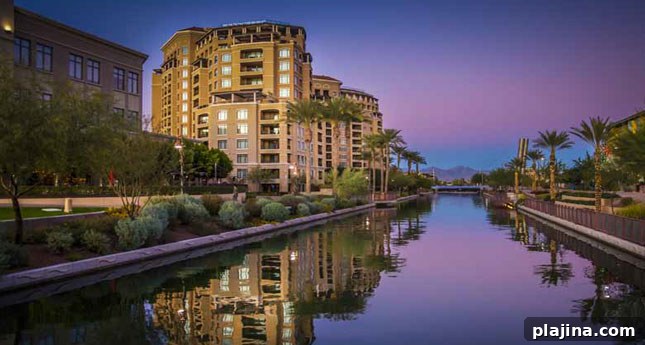
Founder Maj. Winfield Scott would likely be astonished to see modern-day Scottsdale. Once a remote settlement in the Sonoran Desert, Scottsdale has transformed into an upscale, vibrant city that blends Southwestern heritage with contemporary sophistication.
In 1888 Scott acquired more than 600 acres that later became downtown Scottsdale. Early residents were primarily farmers and ranchers, and the fledgling town developed to meet their practical needs. Over time, Scottsdale’s mild climate and striking desert scenery attracted visitors from the East seeking relief from harsh winters. In 1910 the Ingleside Inn opened as the area’s first luxury resort and introduced golf to the region. In 1940, Elizabeth Arden’s Maine Chance spa marked the city’s first resort spa.
Scottsdale incorporated as a city in 1951 and expanded steadily in the decades that followed. By the 2010 census the city covered more than 180 square miles and had a population exceeding 217,000.
The most dramatic expansion occurred in the 1990s, when nearly 38,000 new housing units brought about 82,000 new residents. Rapid growth raised concerns about overdevelopment and erosion of the city’s quality of life. In response, Scottsdale’s city government pursued policies to preserve the community’s character and protect the natural desert environment. Residents approved the acquisition of roughly 36,000 acres to create the McDowell Sonoran Preserve, permanently safeguarding this open space for recreation and conservation.
During the 21st century Scottsdale experienced what many call an urban renaissance. An historic irrigation canal became the axis of a multimillion-dollar Waterfront district featuring modern high-rises with luxury condominiums. Adjacent to it, the SouthBridge District emerged as a premier shopping and dining neighborhood focused on independent local businesses rather than national chains.
Scottsdale has long maintained close ties with local Native American communities, notably the Pima and Maricopa peoples of the Salt River Pima-Maricopa Indian Community (SRP-MIC). Talking Stick, a cultural and entertainment area developed by the community, includes a cultural center, a resort and casino, restaurants, an event venue, and two golf courses. In 2011 the SRP-MIC partnered with Major League Baseball teams to build a modern spring-training complex for the Arizona Cactus League on tribal land—the only such facility on Native American land—featuring an 11,000-seat stadium, multiple practice fields and full clubhouses and training amenities.
Tourism remains the backbone of Scottsdale’s economy. Luxury resorts, championship golf courses and world-class spas make hospitality the city’s leading employer, accounting for a substantial portion of local jobs. Many resorts offer comprehensive on-site experiences: for example, The Boulders sits on 1,300 acres of desert dotted with dramatic rock formations, providing two award-winning golf courses, a 33,000-square-foot spa and miles of hiking terrain.
For visitors seeking smaller-scale accommodations, the Bespoke Inn, Café & Bicycles offers a boutique downtown B&B experience just a short walk from Old Town. Opened in 2013, the four-room inn includes complimentary brunch at its acclaimed Virtù restaurant and provides bicycles for exploring the city.
Scottsdale’s appeal extends beyond lodging. Shoppers enjoy a mix of art galleries, specialty boutiques and malls, while downtown nightlife continues to thrive. The restaurant scene has diversified well beyond traditional steakhouses and Mexican cuisine. Scottsdale ranked second on Livability’s 2014 list of Top Foodie Cities, and locally acclaimed restaurants such as Virtù Honest Craft and FnB have won national recognition for creative, farm-driven cuisine and a strong focus on Arizona wines.
Public art plays a prominent role in shaping downtown Scottsdale into an open-air museum. Scottsdale Public Art has funded numerous projects to enhance the city’s visual landscape and has allocated significant resources to further aesthetic improvements. A major addition to the cultural scene is the Scottsdale Museum of the West, a 40,000-square-foot facility scheduled to open with exhibits showcasing regional art and artifacts that trace the area’s history.
SCENIC DRIVES
Nature lovers and road-trippers will find memorable scenery along the Apache Trail. This historic route, designated AZ88, winds through the Superstition Mountains and offers dramatic canyon views, towering saguaro cactus and striking geological formations. The paved portion begins in Apache Junction and follows a scenic 15-mile stretch to Canyon Lake, one of several reservoirs formed along the Salt River. A few miles farther lies Tortilla Flat, a tiny outpost with a restaurant and general store.
Beyond mile marker 220 the route shifts to a well-graded dirt road for approximately 22 miles. At milepost 222 Fish Creek Hill begins with a steep 1,500-foot descent featuring narrow hairpin turns and steep drop-offs; cautious drivers may prefer to turn back here, while adventurous travelers are rewarded with sweeping desert vistas. Whether taken in a compact car or an SUV, the Apache Trail provides an unforgettable day trip from Scottsdale.