
The forlorn, long-forgotten amusement park swing moved slightly in the breeze. Nearby, an abandoned Ferris wheel groaned softly as the wind passed through its unused cars, creating a scene that could have come straight from a horror film.
That day I discovered it had, in fact, been used as a film location: the amusement park appears in the disaster-horror movie Chernobyl Diaries (2012). More importantly, this place sits in the shadow of the world’s worst manmade nuclear accident—the Chernobyl disaster of April 26, 1986. Standing a few steps from the aging rides, I thought about the scale of the meltdown, the lives affected, and the long aftermath that reshaped the landscape and the people of the region.

Old toys left behind © KIMBERLY KROL
Disaster tourism and urban exploration have continued to grow in popularity, and places like Chernobyl attract increasing numbers of visitors. In 2016 roughly 40,000 people visited the Exclusion Zone, choosing anything from daytrips to multi-day tours. That number has been rising as interest in the site grows.
Is visiting safe? That was a question I — and many who care about me — asked. Before traveling I read many reports and learned that radiation exposure from a single day in the Exclusion Zone can be comparable to a round-trip trans-Atlantic flight. My visit took place more than three decades after the accident, and after researching safety measures, following official guidance and traveling with an experienced operator, I felt comfortable making the trip.
Safety is ultimately a personal decision. I took extra precautions: wearing older clothes and inexpensive sneakers I wouldn’t mind discarding afterward. The Exclusion Zone still supports workers and occasional residents, and life in certain parts continues under strict rules and monitoring.
My daytrip was run by Chornobyl Tour and departed Kyiv around 7:30 a.m. Our meeting point was near Kyiv Railway Station. Entry to the Exclusion Zone requires strict adherence to rules, so bring your passport—without it, you cannot enter. Our group paused outside the zone for about 30 minutes while credentials were checked. Dress code rules are enforced: long sleeves, long trousers (no shorts, skirts, or leggings), and fully enclosed boots or sneakers are required. Expect a full day away from the city—our trip returned to Kyiv near 8 p.m.
On the drive to Chernobyl we stopped for restrooms and snacks while the guide provided background about the disaster and screened a documentary featuring firsthand accounts and historical footage, including remarks by Mikhail Gorbachev. Watching archival clips of residents and workers in Pripyat—built for plant employees and their families just three kilometers from Reactor No. 4—was heartrending. At the time many people were unaware of the danger as officials struggled to respond and conceal the disaster. Radiation detected as far away as Sweden helped reveal the truth. The documentary also outlined the extensive clean-up and containment efforts that followed.
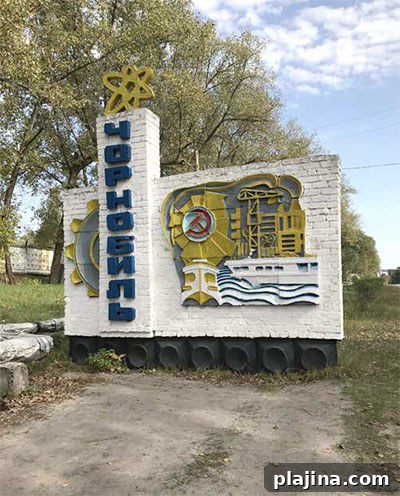
The entrance sign © KIMBERLY KROL
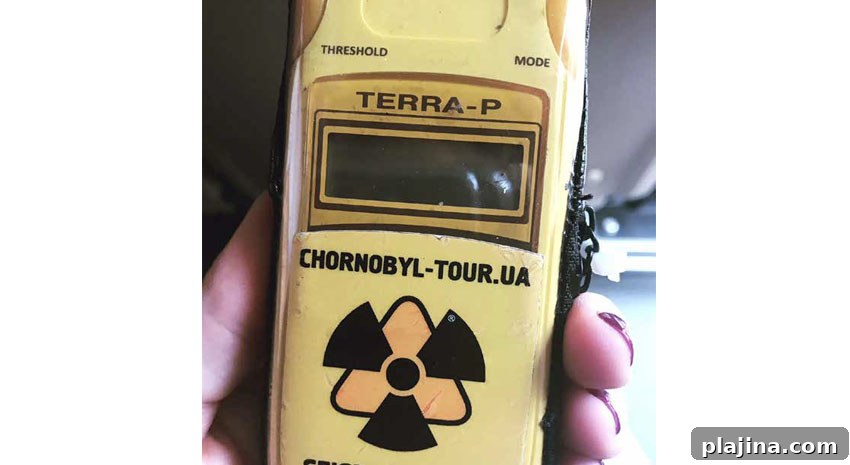
The itinerary included several stops. We entered through the Dytyatky checkpoint, the official gate to the Exclusion Zone, and visited Zalissya, an abandoned village that includes the home of Rozaliya Ivanivna, a well-known self-settler. In Kopachi, much of the village is buried; one remaining building is a kindergarten. Here our Geiger counters—worn around our necks—spiked, recording the highest radiation levels we encountered that day. It was sobering to consider that children attended classes there the day after the fire.
We continued to the reactor site and to the power plant’s cooling pond, where giant catfish surfaced as we fed them. We also visited the massive Soviet-era DUGA-1 radar array near the formerly secret town of Chernobyl-2. Finally we reached Pripyat and explored on foot as nature steadily reclaimed streets and buildings. A once four-lane highway had become little more than a tangled path. Dilapidated apartment blocks, a soccer stadium and everyday items left behind—shopping carts, curtains, and vending machines—bear witness to abrupt abandonment. The amusement park remains an eerie emblem of the town, though many buildings are now off-limits due to collapse risk. Our visit concluded in Chernobyl town with a late lunch, an open-air display of the vehicles and robots used in the cleanup, and a quiet moment at the memorial dedicated to those who worked to contain the disaster.
Before we left the zone, our radiation exposure was checked. My personal dose measured 0.003 mSv for the day.
As we drove back to Kyiv, I left with a deep impression of resilience. The trip reinforced a sense that Ukraine carries a determined spirit of recovery and remembrance.
Chernobyl Info to Go
Most international travelers arrive through Boryspil International Airport in Kyiv. Tour companies arrange transportation from Kyiv to the Exclusion Zone; be sure to book with a licensed operator and confirm what documentation and clothing are required for entry.