
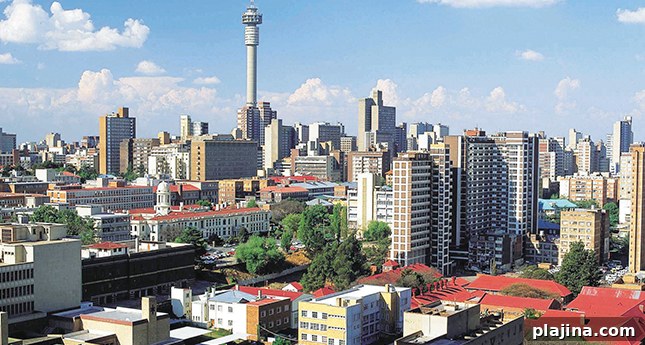
If an extraterrestrial spaceship were to hover over the skyline of a major world city, which city would it choose? In Hollywood films, alien visitors almost always head for New York or Los Angeles. Peter Jackson’s sci-fi hit District 9, however, imagined a more surprising—and arguably more sensible—choice: Johannesburg.
Known variously as Jo’burg, Jozi, or eGoli, Johannesburg is Africa’s great melting pot. The city’s energy is driven by a bold, sometimes chaotic spirit that fuels creativity and commerce, even as social pressures occasionally threaten to spill over.
After the end of apartheid in 1994, Johannesburg drew waves of migrants from across the continent. Many settled in dense downtown areas such as Hillbrow. Public services struggled to keep pace and law enforcement was stretched thin. By the early 2000s, parts of the Central Business District had become a scene of decline and disorder that felt almost apocalyptic.
In recent years, however, the tide has begun to turn. Streets once surrendered to neglect and crime have been reclaimed, and businesses that migrated to the suburbs are returning to the CBD. Stylish apartments are now in demand in neighborhoods that, not long ago, people would have entered only with armed escorts.
The catalyst for much of this transformation was an event as dramatic as any imagined alien arrival: the FIFA World Cup. In June 2010 South Africa hosted the tournament, and Johannesburg staged the opening ceremony, several key matches and the final. The influx of teams, officials and tens of thousands of fans focused global attention and investment on the city.
This moment rivaled the city’s founding boom after prospector George Harrison discovered gold in 1886. That discovery revealed the vast Witwatersrand Reef and triggered a gold rush that built Johannesburg. Over time the region produced roughly 40 percent of all the gold ever mined and remains an economic backbone. Gauteng Province—meaning “Place of Gold”—which includes Johannesburg and Pretoria, generates about a third of South Africa’s wealth and close to 10 percent of sub-Saharan Africa’s GDP.
As in many global cities, reputation and status in Johannesburg are often linked to particular neighborhoods—but in Johannesburg these divisions are especially pronounced. During the city’s early growth, African workers were pushed into shantytowns on the outskirts, and under apartheid these communities were reorganized into sprawling townships like Soweto. With the end of apartheid some neighborhoods became locked into decline while others transformed as longtime residents moved away and new inhabitants arrived.
For many white residents leaving the increasingly troubled CBD, leafy suburbs such as Sandton and Melville offered refuge. These areas remain affluent, featuring upscale shopping centers, premium office space and secure gated communities with private security. Downtown Sandton is often described as the wealthiest square mile on the African continent.
Now that political transitions have settled, Johannesburg is evolving into a more cosmopolitan, inclusive city. Soweto, once a symbol of segregation and deprivation under the Group Areas Act, is experiencing a resurgence as a growing black middle class invests in their neighborhoods. Early efforts focused on basic infrastructure—paving roads and improving utilities—but the World Cup accelerated two major projects that are reshaping Soweto’s image.
The main venue, Soccer City, was rebuilt on the site of the old Orlando Stadium. The impressive 94,000-seat arena was designed to evoke a traditional African calabash warmed by flames. Nearby, the long-delayed Orlando Ekhaya redevelopment repurposed the former Orlando Power Station into a mixed-use complex combining retail, entertainment, housing and university facilities. The power station’s decommissioned cooling towers were painted with vibrant murals and now stand as a striking symbol of Soweto’s renewal.
Ahead of the World Cup, millions were spent renewing Johannesburg’s inner city. A modern CCTV network helped reduce crime and encouraged businesses and residents to return. Public art installations appeared across the CBD: a giant antelope, colorful bovine sculptures, and a statue of Mahatma Gandhi—whose time practicing law in Johannesburg is part of the city’s history, though his legacy remains debated.
Newtown, a downtown cultural quarter, reflects many strands of contemporary Johannesburg. Even during apartheid it was a place where communities mixed at venues like the Market Theatre and Kippies Jazz Club. Newtown became an early focal point for the inner-city revival: the old fruit and vegetable market was transformed into the Museum of Africa, housing exhibits that span human history, while the Turbine Hall—once part of the city’s first coal-fired power station—became a versatile cultural venue. Nearby grain silos are being converted into stylish apartments, signaling how industrial spaces are being reborn.
Newtown embodies Nelson Mandela’s ideal of a “Rainbow Nation.” The hope for national unity seemed to surge in 1995, when South Africa hosted the Rugby World Cup and the national team won the final in Johannesburg’s Ellis Park. Rugby had long been associated with the white minority while soccer—celebrated by the national team Bafana Bafana—was passionately supported across black communities. The 1995 moment proved to be an inspiring start, though divisions persisted.
When the world turned its gaze to Johannesburg for the World Cup, organizers aimed to use the $3 billion event as a catalyst for unity and long-term urban renewal. The tournament offered a chance to move beyond past divisions and to set Johannesburg on a path toward a more confident and inclusive future.
Diversions
Although Johannesburg is a relatively young city, the Highveld has hosted human ancestors for more than 2.5 million years. The Origins Centre at Wits University in Braamfontein explores the evolution of Homo sapiens and provides an excellent introduction to the Cradle of Humankind, a 183-square-mile World Heritage Site about 30 miles northwest of the city. The site includes several dolomite caves with important early human fossils; the Maropeng visitor center (meaning “returning to the place of our origins”) is the main gateway to sites such as the Sterkfontein Caves.
Gold Reef City, located south of the CBD, is an amusement park celebrating Johannesburg’s gold rush era with roller-coasters, mock-Victorian streets and a mining museum. Nearby, the Apartheid Museum offers a challenging and moving account of South Africa’s recent history; visitors receive an admission card denoting “White” or “Non-White” and enter through the corresponding gate to reflect the past social divisions.
For sweeping city views, visit the Top of Africa observation deck on the 50th floor of the Carlton Centre, Africa’s tallest building. Close by, the Johannesburg Art Gallery on the edge of Joubert Park houses an outstanding collection of South African art alongside works by international masters. Newtown also hosts attractions such as the SAB World of Beer, which celebrates brewing culture and recreates a shebeen, a traditional township drinking spot. Soweto tours are widely offered and increasingly popular; visitors can explore the Hector Pieterson Museum that commemorates the 1976 Soweto Uprising and the Mandela House, the preserved home of Nelson Mandela from before his 1962 arrest and after his release in 1990.
Some of Johannesburg’s more unexpected attractions include Montecasino, a vast entertainment complex designed to resemble a Tuscan village, and the Montecasino Bird Gardens for interactive bird shows. For wildlife lovers, the Ann van Dyk Cheetah Centre—about a 90-minute drive north—is renowned for viewing the rare king cheetah as well as brown hyenas and several antelope species; bookings are essential. Kruger National Park is easily reached by air from Johannesburg, and several private reserves along its boundary, including the celebrated Mala Mala, offer top-tier safari experiences.
Info To Go
Flights arrive at O. R. Tambo International Airport (JNB), about 14 miles east of the city center. Many hotels offer courtesy shuttles; a taxi typically costs around $35.
Lodging
Lolo’s Guest House
Run by a retired schoolteacher, Mrs. Mabitsela, this welcoming B&B in Soweto offers comfortable, award-winning hospitality. 1320 Diepkloof Ext., Soweto, tel 27 11 985 9183, $$
Saxon Boutique Hotel and Spa
A prestigious boutique property near Sandton, the Saxon hosted Nelson Mandela while he worked on his autobiography. 36 Saxon Road, Sandhurst, tel 27 11 292 6000, $$$$
The Westcliff
Set among jacaranda trees with views over Johannesburg Zoo, this tranquil, luxurious hotel was founded by the current owner of the Orient Express. 67 Jan Smuts Ave., Westcliff, tel 27 11 481 6000, $$$$
Dining
Addictions Restaurant
A contemporary take on Asian cuisine using local ingredients such as ostrich steak. 137 Greenway Road, Greenside, Melville, tel 27 11 646 8981, $$$
Butcher Shop & Grill
Located on Nelson Mandela Square in Sandton, this popular restaurant highlights the central role of grilled meat in South African cuisine. Shop 30, Nelson Mandela Square, Sandton, tel 27 11 784 8676, $$
Moyo Zoo Lake
One of three Johannesburg branches, Moyo offers inventive interpretations of African dishes in a lively setting. 1 Prince of Wales Drive, Parkview, tel 27 11 646 0058, $$