
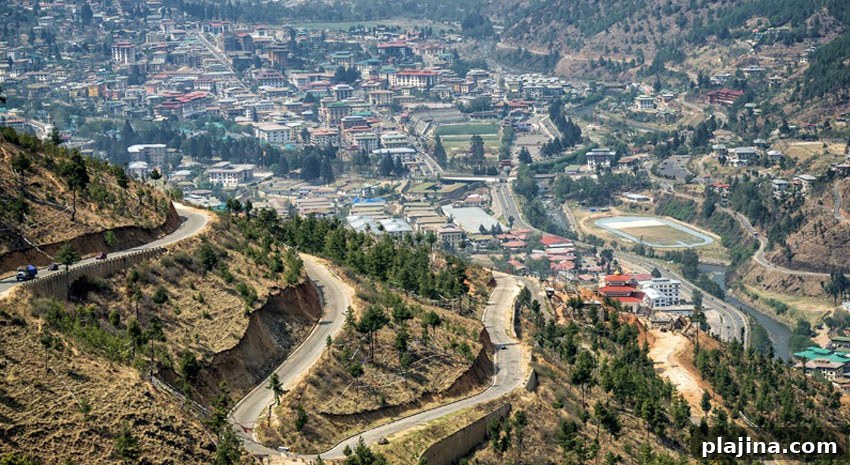
GETTING TO BHUTAN is only part of the journey; navigating the country is the other. This Himalayan kingdom has carefully balanced tradition and modernity, preserving much of its cultural identity while selectively adopting contemporary conveniences. At times you will feel transported to another era; at others a glimpse of a smartphone or a modern lodge will pull you back to the present.
Most visitors arrive by air, and the approach to Paro International Airport is memorable. As the pilot warns, the mountains feel much closer than usual. The Airbus threads a series of valleys, then executes a tight final turn and descent before landing on a runway nestled among steep slopes. The arrival is dramatic: stepping onto the apron, you breathe crisp mountain air and pass into an ornately decorated terminal that evokes a Buddhist temple, with forested peaks surrounding the airfield.
Bhutan promotes itself as one of the world’s greenest nations. Its extensive virgin forests absorb millions of tons of carbon a year, outweighing the nation’s own emissions and making Bhutan effectively carbon-negative. The government has committed to organic agriculture and ambitious waste-reduction goals, and environmental protection shapes policy across sectors.
Although Paro lies roughly 14 miles from Thimphu in a straight line, road travel rarely follows a direct route. Mountain roads wind along narrow valleys, cross rivers and climb high passes, so distances take longer than they appear on a map. Recent improvements to the main east–west highway have reduced travel times: the drive from Paro to Thimphu now takes about an hour over 34 miles.
Thimphu sits in a wide, picturesque valley and has seen thoughtful modernization without losing a distinctly Bhutanese character. Buildings — including international hotels — respect traditional styles, featuring wood-framed windows, painted facades and roofs with overhanging eaves. When the city briefly tried traffic lights, residents found them impersonal and requested the return of traffic police to direct intersections; the resulting choreography of officers is a small but charming aspect of daily life.
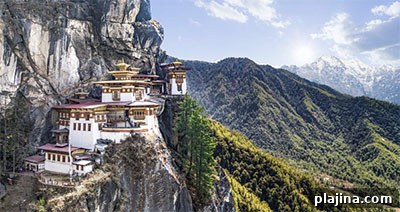
Taktshang Goemba © PICHAYA P – DREAMSTIME.COM
Bhutan’s careful approach to foreign investment and development preserves its environment and culture but can slow business formation. Hydropower is the dominant industry, tapping powerful rivers to produce electricity for domestic use and export. Agriculture remains central to local life, with rice, maize and chili peppers important to diets and livelihoods.
Tourism is managed under a policy of “high-value, low-volume” visitation. The government sets daily tariffs for foreign visitors and encourages travel through licensed operators rather than unregulated independent travel. These measures limit visitor numbers and generate revenue for conservation and cultural preservation, helping maintain Bhutan’s special atmosphere.
A highlight for many visitors is attending a tshechu, a colorful religious festival staged at regional dzongs — fortress-monasteries that dominate town skylines. During a tshechu, masked dances and ritual performances draw crowds in traditional dress, many traveling long distances to attend. The experience is lively, communal and steeped in centuries of tradition.
The Kingdom of the Thunder Dragon remains distinct in a globalized world, where centuries-old customs continue to thrive alongside selective modern comforts.
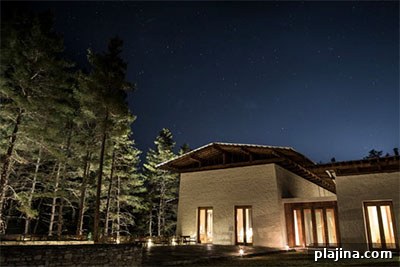
Amankora Lodge Thimphu exterior © AMAN RESORTS
CHECKING IN WITH JOHN REED
Country Manager, Amankora Lodges
How long have you been in Bhutan?
About 16 years; I arrived in April 2003.
How important are environmental considerations for Amankora?
Extremely important. From the start we have focused on minimizing our footprint: efficient water treatment, energy conservation, waste segregation for recycling and composting, eliminating single-use plastics and bottling our own water. We also work with suppliers to reduce packaging and support sustainable practices in the supply chain.
What cultural differences should American visitors know?
The Bhutanese are welcoming and treat visitors with respect. English is widely spoken, but visitors should be mindful of local reverence for the king, the royal family and Buddhist religious traditions. Bhutanese people enjoy humor and camaraderie, yet they also demonstrate deep respect for their culture and faith.
What developments are underway?
The recent completion of the upgraded east–west highway has shortened travel times between lodges, improving guest experiences. We are also expanding lodge amenities with enhanced spa facilities, swimming pools and a couple of high-altitude trekking camps to broaden our offerings.
Which attractions do you recommend?
Highlights include Tiger’s Nest (Taktshang) and Kyichu Lhakhang in Paro; Cheri Goemba and Simtokha Dzong in Thimphu; the Giligang trail and Punakha Dzong in Punakha; the Longtey trail and monastic training school in Gangtey; plus Tamshing Lhakhang and the beer and cheese factory in Bumthang. Each region offers its own unique sites and experiences.
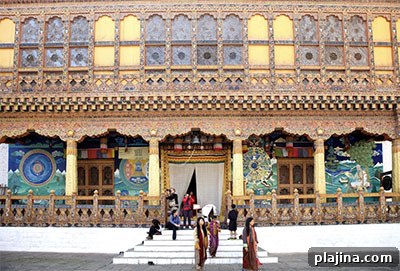
Intricately carved wooden façade and mural paintings at Punakha Dzong © ANTONELLA865 – DREAMSTIME.COM
Things to Do in Bhutan
Taktshang Goemba, known as Tiger’s Nest Monastery, is Bhutan’s most iconic site and a must-see. Perched on a cliff, the monastery requires a demanding uphill trek. From the trailhead an ascent of roughly 1,800 feet brings you to a viewpoint opposite the monastery. The high-altitude hike is strenuous, but a café near the top offers a chance to rest. Those unwilling to hike can ride part of the way by mule, but the final approach must be completed on foot. The monastery was carefully restored after a 1998 fire and reopened in 2005; it remains visually and spiritually powerful.
Each major town centers on a dzong — a combined fortress and monastery that often welcomes visitors and hosts annual tshechus, vibrant religious festivals. If possible, check festival schedules in advance, as dates follow the lunar calendar and can shift. Many visitors choose to wear traditional dress (men wear the gho; women the kira) when attending a tshechu to show respect and to deepen the cultural experience. Popular tshechus take place in Paro (March), Thimphu (September) and Bumthang (November).
Archery is Bhutan’s national sport, and weekend tournaments in Paro and Thimphu provide entertaining displays of skill and friendly rivalry. For outdoor enthusiasts, trekking in central regions like Bumthang offers a chance to explore remote valleys, meet local communities and visit secluded monasteries.
Bhutan Info to Go
International flights land at Paro International Airport, located about four miles from Paro town and 34 miles from Thimphu. Scheduled connections link Paro with cities such as Bangkok, Delhi, Kathmandu and Singapore. Due to mountainous terrain, visibility-related delays and diversions are common; aircraft carry extra fuel in case a landing is not possible. Overland entry from India is available at several points, with Phuentsholing being the main border crossing; the drive from Phuentsholing to Thimphu takes roughly five hours.
Bhutan: Just the Facts
Time zone: GMT +6
Phone code: 975
Currency: Bhutanese ngultrum
Key industries: Hydropower, agriculture, forestry, tourism
Official language
Dzongkha is the national language. English is widely spoken and serves as the medium of instruction in schools.
Coming and going
All U.S. citizens need a passport valid for at least six months after arrival and must secure visa clearance before travel. Visa processing takes at least seven working days, and airline tickets should be purchased only after visa approval. On arrival, travelers must provide two passport photos and pay a visa fee (currently $40). In addition, a daily tariff is charged to foreign visitors (rates vary seasonally). Visitors staying longer than six months are required to undergo an HIV/AIDS test.
Where to Stay in Bhutan
AMANKORA BUMTHANG LODGE — A 16-suite lodge offering understated luxury and a restorative spa, ideal after trekking in the Himalayas. Jakar, Bumthang.
AMANKORA PARO LODGE — One of several Amankora lodges, noted for minimalist design and tranquil surroundings; conveniently close to Paro airport. Near Kuenga Chhoeling Palace, Paro.
LE MÉRIDIEN THIMPHU — A recent example of an international hotel adapting to Bhutanese architectural style, located near Chorten Lam in Thimphu.
Restaurants in Bhutan
BUKHARI — Located at COMO Uma Paro, Bukhari serves an eclectic international menu alongside Bhutanese options in a warm dining room arranged around a stone fireplace. Paro Valley, Paro.
FOLK HERITAGE MUSEUM RESTAURANT — A favorite for sampling Bhutan’s bold, spicy cuisine, located in Kawajangsa, Thimphu.
THE SWISS GUEST HOUSE — Set in chalet-like surroundings in Jakar, Bumthang, this establishment reflects Bhutan’s long friendship with Switzerland and offers Swiss dishes such as fondue and bratwurst alongside local specialties.