
In 1867 Lewis Carroll wrote in his diary about St. Petersburg, “It is as though one walked through a city built for giants.” That impression reflects not only the stature of Peter the Great, who measured 6 feet 8 inches, but also the grand scale and deliberate majesty of a city conceived to be Russia’s imperial showcase.
Founded by Peter the Great in 1703, St. Petersburg served as the imperial capital for centuries and today remains Russia’s cultural heart. The city is famed for world-class ballets and operas, ornate palaces and vast museums. Its architecture and planning drew inspiration from Western Europe—Amsterdam in particular—so St. Petersburg often feels like Russia’s most European city.
Griboyedov Canal with the Church of Our Savior on the Spilled Blood Photo: © Pavelvasenkov | Dreamstime.com
Positioned on the Baltic Sea, the city’s network of rivers and canals has earned it the nickname “Venice of the North.” From the Griboyedov Canal to the mighty Neva River, St. Petersburg offers stately architecture, rich historical layers and a lively cultural calendar year-round. Many of Russia’s greatest creative figures—Pushkin, Gogol, Dostoevsky, Rachmaninoff, Tchaikovsky and Shostakovich—made their homes here, helping shape the city’s artistic legacy.
Today more than 5.2 million people live in St. Petersburg, making it Russia’s second-largest city and one of Europe’s largest. The city remains a major economic center, with industry and tourism as twin pillars of its economy.
St. Petersburg benefited from significant Soviet-era investment in heavy industry, research and military production. It continues as Russia’s principal center for military and civilian shipbuilding and repairs. Other important sectors include ferrous and non-ferrous metallurgy, chemicals and medical equipment manufacturing. Several international automakers operate plants in the surrounding region.
Brewing is another notable local industry. While vodka has long been Russia’s most famous spirit, St. Petersburg is often regarded as the nation’s beer capital thanks to abundant high-quality water. The city is the largest beer-brewing center in Russia, with several major breweries producing roughly 30 percent of the country’s beer.
Tourism is thriving as well. The World Travel Awards named St. Petersburg Europe’s top tourist destination in 2015, praising its deep history, enduring traditions and vibrant future.
At the same time, economic pressures—such as a falling ruble linked to lower oil prices and international sanctions—have affected Russia’s broader economy. The weaker currency, however, has made travel to St. Petersburg particularly affordable for many international visitors.
Things to Do in St. Petersburg
Grand architecture and lavish detail define St. Petersburg’s character. Walk Nevsky Prospekt, the city’s main avenue, and you’ll encounter historic palaces, elegant churches, cafés and theaters at every turn.
Art on display at The State Hermitage Museum © Ukrphoto | Dreamstime.com
The State Hermitage Museum, housed in the Winter Palace, is one of the world’s great art institutions. Formerly the residence of the tsars, the museum holds a collection of more than three million items and draws millions of visitors annually.
The Mariinsky Theatre is another essential experience—home to some of the world’s most renowned ballet and opera performances. For history and panoramic views, visit the Peter and Paul Fortress, the city’s original citadel, where the Peter and Paul Cathedral contains the tombs of many Russian tsars and a gilded spire topped by an angel.
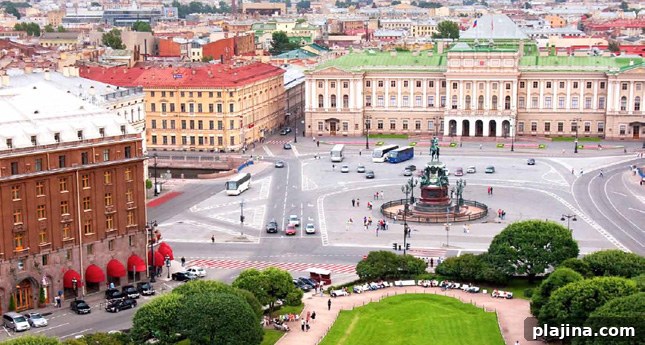
St. Isaac’s Cathedral, with its massive gilded dome, dominates the skyline as the city’s largest Orthodox cathedral. For vivid mosaics and onion domes, the Church of Our Savior on the Spilled Blood commemorates the assassination site of Emperor Alexander II and showcases richly colored exterior and interior decoration.
About 30 minutes outside the city in Pushkin stands the Catherine Palace, a Baroque complex famous for the recreated Amber Room. The original amber panels were looted during World War II and remain missing; a painstaking restoration was completed in 2003.
CHECKING IN WITH DAVIDE CASTELLUCCI AND ANASTASIA DRUZHEVSKAYA
Founders and Publishers, St-Petersburg-EssentialGuide.com
Why should travelers come to St. Petersburg?
Anastasia: St. Petersburg is among the most beautiful and culturally rich cities in Europe. It offers a wealth of sights and activities. People are generally friendly and the city is relatively safe compared with many global destinations.
What is your favorite thing to do in St. Petersburg?
Davide: I enjoy pairing an evening at the theatre with coffee and pastries at Café Pyshechnaya, then walking along Nevsky Prospekt. Nevsky is the city’s heart—full of hotels, restaurants, bars, shops and cultural venues. The avenue mixes the newer, trendier areas with older, nostalgic corners.
Anastasia: Being born in St. Petersburg, I can’t go long without visiting museums, cathedrals, exhibitions and theaters. Tourists should not miss the ballets at the Mariinsky Theatre, which combine exceptional performances with an imperial interior.
Any new hot spots you particularly like?
Davide: In addition to Café Pyshechnaya, I recommend regional restaurants such as Mamaliga and Cinema Rodina, one of the city’s oldest cinemas housed in an elegant historic building. The Russian Vodka Room No. 1 and the Rossi Hotel and SPA near the canal are also favorites.
Anastasia: New seasonal offerings include hop-on, hop-off boat tours on the Neva and its canals, dinner cruises and evening music cruises—an excellent way to experience the city from the water.
If you had to leave St. Petersburg tomorrow, what would you remember most?
Davide: I would remember the State Hermitage and Palace Square, evening canal cruises on the Neva, the variety of restaurants and theaters, leisurely walks along Nevsky Prospekt and a traditional Russian sauna.
St. Petersburg Info to Go
The modern Terminal 1 at Pulkovo Airport, located to the south of the city, handles over 17 million passengers annually. St. Petersburg also has five railway stations and road connections to Moscow, Finland, Estonia and Belarus.
St. Petersburg: Just the Facts
Time Zone: GMT +3
Phone Code: Country code: 7 City code: 812
Currency: Russian ruble
Entry/Exit Requirements: Travelers must have a valid passport and a Russian visa issued by an embassy or consulate; visas cannot be obtained on arrival.
Official Language: Russian, with some Estonian and Finnish spoken in local communities.
Key Industries: Shipbuilding and repair, research, brewing, automobile production, tourism
Where to Stay in St. Petersburg
Four Seasons Hotel Lion Palace A former royal residence offering classical luxury and 19th-century elegance near the State Hermitage Museum. 1 Voznesensky Prospekt $$$$
Hotel Astoria A grand hotel on St. Isaac’s Square with opulent public spaces and contemporary guestrooms. 39 Bolshaya Morskaya $$$
Kempinski Hotel Moika 22 A restored Romanov-style property on the Moika River Embankment combining antiques, modern comforts and Turkish steam baths. Moika River Embankment 22 $$$$
Restaurants in St. Petersburg
L’Europe A historic restaurant in the Belmond Grand Hotel Europe, renowned for luxurious Russian specialties including caviar, set in a Neo-Baroque/Art Nouveau landmark. Belmond Grand Hotel Europe, 1/7 Mikhailovskaya St. $$$$
Feodor Dostoevsky Restaurant Located in the neighborhood where the author lived, this restaurant serves refined Russian and European dishes with old-world hospitality. Golden Garden Boutique Hotel, 9 Vladimirsky Prospekt $$$$
Palkin Established in 1785, Palkin combines tsarist-era opulence with classic Russian cuisine and an atmosphere that once welcomed figures like Tchaikovsky and Dostoevsky. 47 Nevsky Prospekt $$$$