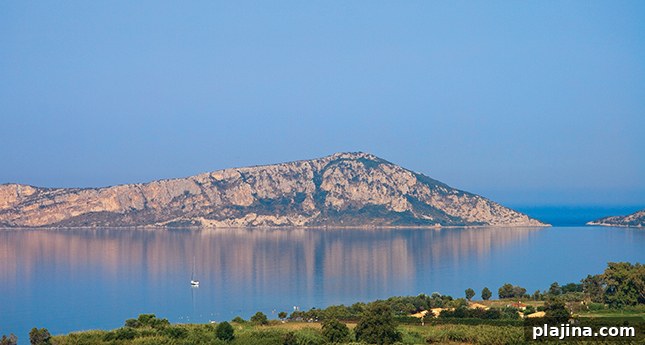
There are roughly 1,400 Greek islands scattered like confetti across the seas that embrace the mainland — each island a fragment of paradise shaped by its history and mythology.
Yet even after visiting many of them, I found something different at Costa Navarino: a rare combination of natural beauty, thoughtful luxury, rich history and refined style. This new resort sits on the southwestern tip of the Peloponnese, the hand-shaped peninsula that forms the southern mainland of Greece.
During a 10-day trip I traveled to Páros, Náxos, Mílos, Mykonos and Santoríni, relishing the lime-washed villas and sheer cliffs of the Cyclades. Still, when I arrived in Kalamata, capital of Messinia, I discovered a place of a different character — an unusually lush, largely unsung region known more for its archaeology than for mainstream leisure tourism.
Most travelers begin in Athens, ticking off highlights such as the Acropolis, the Acropolis Museum, the Parthenon, the Plaka neighborhood and the National Archaeological Museum, before hurrying to Piraeus to catch a ferry to the islands. What they often miss, however, is Messinia’s distinctive offering: expansive sandy beaches, dramatic coastal scenery, stylish hotels and a layered history that can rival many islands. The region’s wetlands support rich biodiversity, including numerous rare and endangered plant and animal species.
Native son Vassilis Constantakopoulos understood Messinia’s value. In the early 1980s the master seaman and shipping entrepreneur began acquiring pristine coastal land around Navarino Bay — a historic stretch of water where the wreckage of the Ottoman armada, defeated in 1827, is still visible. Motivated by a desire to promote Messinia while preserving its natural beauty, he set out to create a sustainable, high-end resort that respected the environment.
His vision became the Tourism Enterprises of Messinia and its flagship development, Costa Navarino, planned in multiple phases. The first phase, Navarino Dunes, opened with two luxury hotels: the Romanos and the Westin, a large conference center and the Anazoe Spa, which draws on the principles of Hippocratic healing. The resort spans 350 acres and includes two signature 18-hole golf courses — one designed in collaboration with Bernhard Langer and European Golf Design, the other by Robert Trent Jones, Jr. — plus family programs that teach children about Greek mythology and local olive-oil traditions.
Messinia’s appeal comes in part from its relative remoteness and the scarcity of modern intrusions. Even as development arrived, Constantakopoulos acted to protect the region’s environmental integrity. He partnered with the Hellenic Ornithological Society and other conservation organizations, supported protection efforts for the endangered loggerhead sea turtle, and allocated a portion of the resort budget to environmental practices. Before construction began, large reservoirs were built to supply the resort’s projected water needs, including its golf courses.
The resort’s conservation efforts continue: Costa Navarino joined the United Nations Environment Programme’s Plant for the Planet campaign, pledging to replant thousands of olive and citrus trees, and helped establish the Navarino Environmental Observatory in collaboration with the University of Stockholm and the Academy of Athens to study climate change and its effects on the Mediterranean environment.
The drive from Kalamata along National Road 82 offers a window into the region’s deep past — the Bronze Age landscape Homer described, including the Palace of Nestor, the seat of the wise king of “Sandy Pylos.” Arriving at the Romanos hotel, I expected a jolt of modernity, but instead found architecture inspired by traditional Messinian mansions, built largely from local stone. The result feels both grand and welcoming, an appropriate setting for the ancient Greek custom of treating guests as honored visitors.
Diversions
Navarino Dunes functions as a destination in its own right. It offers a wide range of leisure options: an indoor basketball court, a retro bowling alley, the Navarino Racquet Academy, two championship golf courses, a 43,000-square-foot spa and a private beach. The resort also serves as an excellent base for exploring Messinia’s archaeological and cultural sites.
The Mycenaean-era Palace of Nestor is among the most important nearby sites, noted for its frescoes and the cache of inscribed clay tablets that record an early form of Greek. Rediscovered by Carl Blegen in 1939, the palace crowns Tantárna’s low ridge (Ano Englianos) and overlooks Navarino Bay, the scene of the decisive naval engagement of 1827. Nearby, the Archaeological Museum of Chora houses fresco fragments and plaster casts of the tablets.
Pylos is a charming harbor town centered on a lively plateia with arcaded shops and cafés looking out over colorful boats. Visitors can enjoy a café frappé, take boat trips to the tiny island of Sphacteria — a notable Peloponnesian War battlefield — or explore the imposing Fortress of Methoni, which stretches along a narrow peninsula and includes tunnels and ramparts reflecting centuries of Venetian and Ottoman presence.
Natural highlights include the Bay of Voidokilia, a circular lagoon and beach often cited among the world’s most beautiful. The bay is the trailhead for hikes to Nestor’s Cave, associated with mythic tales of Hermes and Apollo’s cattle, and to the Tomb of Thrasymedes, an early beehive (tholos) tomb.
Within a short drive are two of Greece’s most significant archaeological destinations beyond Messinia: Olympia, north in Elis, the birthplace of the ancient Olympic Games with the Temple of Hera and the Temple of Zeus; and Mystras, the atmospheric Byzantine citadel on Mount Taygetus near modern Sparta, renowned for its monasteries, churches and vivid murals.
For shopping and local specialties, Kalamata’s historic center offers boutiques selling silk kerchiefs, hand-painted pottery and regional foodstuffs such as olives, figs, wine and honey. Navarino Dunes also includes an Agora with cafés, bars, shops, a traditional amphitheater and an open-air cinema for guests’ enjoyment.
Info To GoMost visitors prefer to fly rather than drive the 168 miles from Athens. Daily flights operate between Athens International Airport (ATH) and Kalamata International Airport (KLX), which is less than seven miles from Kalamata and roughly 31 miles from Costa Navarino. Bus service to the resort is limited; taxis to Costa Navarino are available. Through an arrangement with a rental provider, guests can arrange transfers or car rentals for the airport journey. |
LodgingClassical Filoxenia Hotel A 4-star beachfront property located at the foot of Mount Taygetus, about 10 minutes from the airport. Navarino Street, Kalamata. $$$ The Romanos, Costa Navarino Opened in 2010, this hotel is a cluster of low-rise villas set among olive groves; many ground-floor rooms feature private infinity pools. Navarino Dunes, Costa Navarino. $$$$ The Westin Resort, Costa Navarino Adjacent to The Romanos, this 455-room hotel provides a more contemporary complement to Navarino Dunes. Navarino Dunes, Costa Navarino. $$$$ |
DiningEleon At The Romanos, Eleon’s open kitchen prepares traditional dishes such as grilled octopus, baked lamb and eggplant casserole. The Romanos, Navarino Dunes, Costa Navarino. $$$$ Oasis An à la carte taverna above Navarino Bay that sources fresh fish and produce from local suppliers and an organic garden. Gialova-Pylos. $$ Rex Located in the historic Hotel Rex in Kalamata’s center, this restaurant offers traditional and international fare year-round. Aristomenous 26, Kalamata. $$ |