
First came the dark, then the sharp, mineral scent as I stepped into a structure carved into a halite (rock salt) hill. Located about two hours north of Bogotá near the village of Zipaquirá, the Catedral de Sal is built within the tunnels of an old salt mine. Nearly 13 million visitors have passed through, but all I could focus on at first was keeping from hyperventilating.
Did I mention I’m claustrophobic? Deep, damp caves trigger that creeping, tightening fear. I can zipline hundreds of feet above the ground and once hung from a hang glider at 3,000 feet, but descending into the earth almost brought on a panic attack. Yet there I was, thousands of miles from home, trying to quiet my phobia and wondering if visiting Colombia had been a mistake.
“It’s not safe!” and “You’ll be kidnapped!” were typical reactions from family and friends when I said I was going to Bogotá. The Colombia tourism board embraces the country’s turbulent past with the bold claim, “The only risk is wanting to stay.” Assurances of improved safety, the lure of its cuisine, the country’s varied landscapes—from rugged mountains to fertile countryside—and this adventurous day trip to the Salt Cathedral convinced me to go.
A renowned tourist attraction and a religious destination for many Catholics, the Salt Cathedral is a Roman Catholic church carved inside a working salt mine. The carvings and sanctuaries inside the tunnels are said to be so moving that visitors speak in hushed tones, almost expecting to hear angels sing. That sense of wonder shrank a bit when I read one unsettling fact: parts of the site lie 200 meters underground—more than 656 feet—enough to make anyone gulp.
Crammed into an old Mazda with four others, the 90-minute drive north through the Andean highlands toward Zipaquirá offered plenty to distract me. The region remains largely agricultural: dairy cattle graze on the hills while greenhouses grow cut flowers for export—Colombia is the world’s second-largest rose producer, employing hundreds of thousands and exporting most of its blooms to the United States.
About five minutes from the mine, we detoured onto cobblestone streets and into Zipaquirá’s central plaza at roughly 8,700 feet above sea level. Nestled beneath the surrounding hills, the town keeps many well-preserved buildings with neocolonial architecture, balconies, decorative windows and thick walls showing Moorish influence.
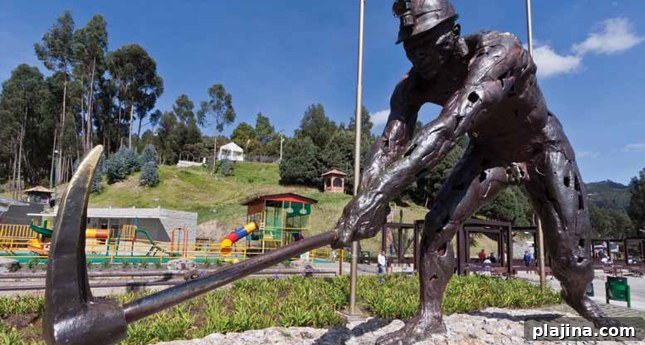
We left the historic square and climbed a winding road to the Salt Cathedral, entering the Parque de la Sal where hundreds of flags flutter over the Plaza del Minero. All visits to the cathedral must be guided, and the 79-acre park offers several attractions: the Museum of Mining, an opportunity to don hard hats for a real mine tour, and Colombia’s tallest climbing wall, the Wall Tree. A metal statue of a miner atop a block of rock salt stands at the park’s center.
As I entered the mine, I passed beneath a focal sculpture of the Virgen de Guasá—translated as “salt and water”—with a miner at her feet. The descent was gradual and chilly, the damp air only partially relieved by my jacket. A neon-lit passageway led into near total darkness, and for a moment I shivered. Soon, lights revealed high ceilings and walls carved with salt that felt gritty under my fingers.
Hundreds of tourists move through the tunnels daily, yet even with multiple languages drifting around, a respectful quiet pervades. As I continued downward, a contemplative atmosphere settled over me; the low, informative murmur of our guide felt comforting rather than alarming.
Geologically, the salt here formed some 70 million years ago as the Eastern Mountains rose and the sea receded, leaving one of the world’s largest salt deposits. The ancient Muisca people were the first to benefit from this resource. Later, the Spanish dubbed the area the “City of Whites,” and two centuries ago the mine’s wealth helped finance the independence campaigns led by Nariño and Bolívar that shaped Colombia, Ecuador, Peru and Venezuela. Today the salt mine and its cathedral continue to bring economic benefit through tourism.
Long before an underground church was formally constructed, miners had carved a sanctuary inside the active mine where they prayed daily for protection under the patron saint, Our Lady of the Rosary. The first formal Salt Cathedral—completed in 1954—featured three naves and a monumental cross that cast a vast shadow on the ceiling. Structural issues forced its closure in 1990.
A new cathedral project followed a design competition. From 44 proposals, designer Roswell Garavito Pearl was chosen, with engineering led by Jorge Enrique Castelblanco Reyes. Construction began in 1991 and required removing about 250,000 tons of rock salt from a depth of 656 feet. The rebuilt cathedral opened in 1995 and quickly became a major site of pilgrimage and tourism.
Today the Salt Cathedral welcomes tens of thousands of visitors annually, most of them Colombians. Its unique design, precise engineering and cultural significance earned it recognition as the First Wonder of Colombia in 2007 and a nomination among modern wonders.
The approach through the 14 Stations of the Cross prepares visitors for the cathedral itself. Walking those stations—each carved into separate chapels formed from earlier mining cavities—was deeply moving. Each cross and kneeling platform is carved into the halite, and carefully placed lighting gives the scenes an almost otherworldly glow. Moist salt walls, dripping stalactites and distant sounds of miners at work add to the solemn, sacred atmosphere.
The cathedral chamber is unexpectedly grand: a cylindrical space with a smooth domed ceiling. A long tunnel reveals an illuminated cross in the distance before opening to a balcony that overlooks the main altar and worship area where weddings and Sunday services are held. An angel statue blowing a horn presides over three staircases that lead to the main level, each labeled with a choice—Sin Pecado (Without Sin), Con Poco de Pecado (With Little Sin) and Con Mucho Pecado (With Much Sin). I chose the third and continued down into the space.
Three interconnected naves are separated by a large crack symbolizing Christ’s birth and death; sculptures by miners and artists fill the space, including reproductions of famous works such as Michelangelo’s Creation of Adam and La Pietà. Four cylindrical columns represent the Four Evangelists. Dominating the interior is a white-illuminated cathedral cross, carved into the salt wall and standing 53 feet tall and 32 feet wide—an awe-inspiring focal point.
Before leaving, we visited exhibits dedicated to the Muisca miners, paused at a rectangular reflecting pool of salt water and stopped in the gift area. My guide noted a fitting geological irony: over time the salt walls will naturally creep back, slowly closing the carved spaces. Many Colombians find poetic meaning in that eventual return to the mountain—an acknowledgment that nothing remains unchanged forever.
Info To Go
Flights arrive at Aeropuerto Internacional El Dorado (BOG), Bogotá’s main airport. The Salt Cathedral of Zipaquirá is about a two-hour drive north. Public buses take roughly three hours, and on weekends and holidays Bogotá’s tourist train, the Tren Turístico de la Sabana, provides a scenic alternative. Bogotá is a busy metropolis with lodging options for many budgets.
The Salt Cathedral is open every day: Monday–Friday, 9 a.m.–4:30 p.m.; Saturday and Sunday, 9 a.m.–5 p.m. Sunday Mass is at 1 p.m. Admission ranges from about $9 to $15 depending on included attractions. Plan at least an hour for the mine tour; English-speaking guides are typically available at no extra charge.