
Montenegro, which has experienced rising tourist arrivals in recent years, has announced a major new cultural project. The Ministry of Spatial Planning, Urbanism and State Property revealed the winning entry in an international competition for a Museum District and Park of Arts & Culture in Podgorica, the country’s capital.
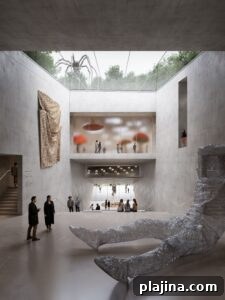
© Emmeworks for a-fact
The winning proposal was led by A-fact Architecture Factory, a Milan- and London-based practice, in collaboration with LAND, Maffeis Engineering and Charcoalblue. Selected from 48 international entries by an expert jury, the project will create a consolidated cultural district that brings together the Museum of Contemporary Art of Montenegro, the Natural History Museum of Montenegro and a new Park of Arts & Culture. The scheme aims to reconnect the city with the Morača River through a carefully designed landscape.
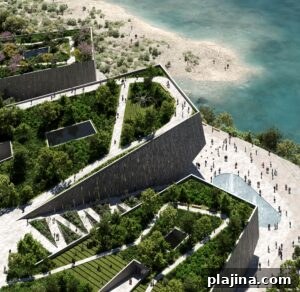
© Emmeworks for a-fact
Located between Gorica Hill and Malo Brdo Hill, the site occupies a prominent urban setting. The design draws on Montenegro’s distinctive natural landscape and Podgorica’s historic character, including the Old Town areas such as Stara Varos. The guiding concept interweaves built form and green space, creating a district where architecture and nature are mutually enhancing.
Two complementary contexts form an interconnected green platform: the Park of Arts & Culture, positioned nearer the city and planted densely, and the Morača River Park, set at a lower elevation and designed to interface with the river’s dynamics. Morača River Park is conceived to safely accommodate extreme flood events while fostering public engagement with the waterfront.
Materials and form take inspiration from the surrounding mountains. Stone cladding references the regional terrain and gives the buildings a durable, contextual identity that enhances views across the park and river. Where building mass is removed from the ground, generous green roofs reinstate surface and circulation, creating accessible outdoor terraces with views over the riverwalk. These vegetated roofs blur the boundary between architecture and landscape, improve habitat connectivity and support local biodiversity.
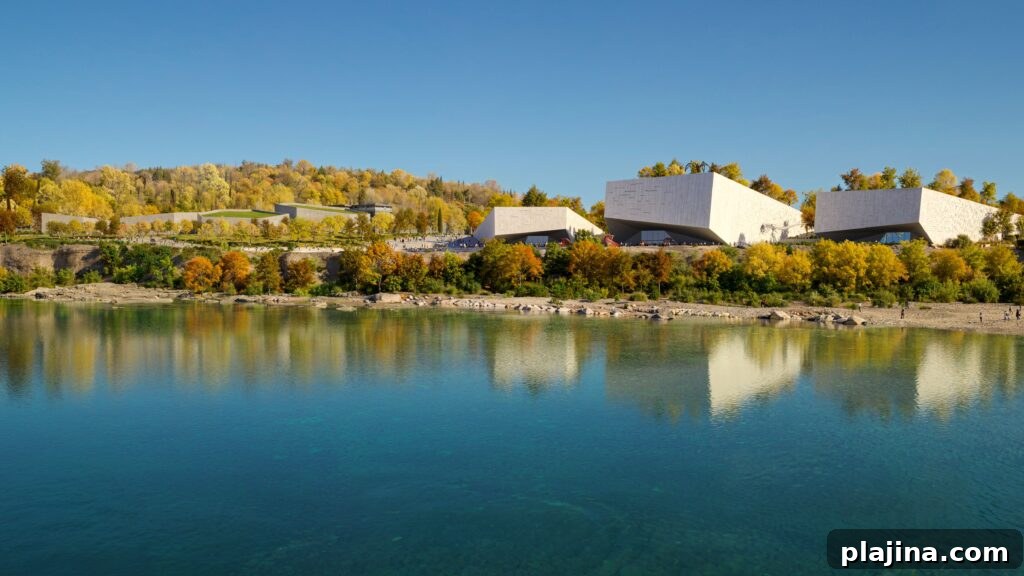
© Emmeworks for a-fact
The new district will provide spaces for permanent and temporary exhibitions, research laboratories, informal meeting areas, a botanical garden and a large flexible outdoor event space that capitalizes on the riverfront setting. Programming will prioritize cultural exchange, public events and activities that celebrate local arts and heritage, positioning Podgorica as a destination for both residents and international visitors.
Sustainability is central to the design. The project integrates passive and active environmental strategies to reduce energy demand for heating, cooling, lighting and potable water use. Modern construction methods and the use of local materials are intended to extend building life cycles and lower embodied carbon, while landscape strategies support resilience and biodiversity.
The landscape plan emphasizes blue-green infrastructure and builds on an in-depth site analysis to preserve existing ecological value. The proposal retains 290 existing trees, adds 532 trees of varied species and introduces 900 new shrubs to strengthen habitat diversity. Improved connections between the museum park, the riverfront and adjacent neighborhoods will enhance access for residents and visitors. The project’s estimated completion target is 2030.
“When completed, this architecture will create a new river landscape that reconnects the river with the city,” said Andreas Kipar, founder and CEO of LAND. “The project contributes to river regeneration in line with the European Nature Restoration Law.”