
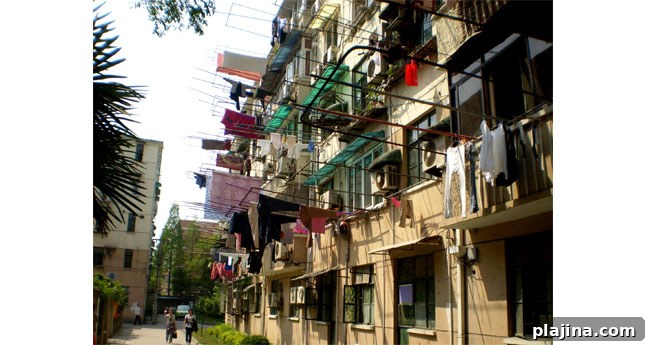
In Shanghai’s rush to modernize, city leaders long overlooked the cultural and historical value of the city’s original longtangs or lilongs: compact neighborhoods of low-rise wooden houses connected by narrow alleys with a single gate opening on to a central courtyard. Some of these lilongs date back centuries, while others were built in the mid-1800s to shelter the waves of new arrivals to the city. After fires destroyed many wooden dwellings, residents rebuilt in sturdier stone and brick while preserving the characteristic gated alleyway and courtyard layout. These later developments became known as shikumen, meaning “stone-framed door.” By the end of the 19th century, Shanghai contained nearly 9,000 lilong and shikumen neighborhoods.
Most of the original wooden lilongs have long disappeared, lost to fire or demolition to make way for high-rise apartments and commercial projects. Numerous shikumen also vanished, though some have been sensitively restored or re-created. Redeveloped areas such as Xintiandi and Tianzifang showcase reconstructed shikumen facades and have become popular destinations, now housing upscale restaurants, bars, clubs and boutiques in buildings that evoke the past.
In recent years, urban planners, preservationists and residents have pushed for greater protection of these iconic neighborhoods. It has become harder for authorities to clear out communities and level the lanes indiscriminately. If you want to experience the few remaining shikumen neighborhoods that still function as residential communities, explore parts of the city on foot. Main thoroughfares that lead to preserved alley networks include Jianguo West Road, Fuxing West Road, Hefei Road, Dongtai Road, Huaihai Zhong Road, Huashan Road, Yan’an Zhong Road, Xinzha Road, Changsha Road, Xinchang Road and Xiamen Road.
Leave the boulevards and step through one of the open metal gates into the alleys to discover lively, intimate street life tucked between Shanghai’s glass towers. Narrow lanes open into shared courtyards where neighbors chat, children play and daily routines unfold—scenes that reveal a different pace of urban life. The alleys are generally safe at any hour, but be courteous and ask permission before photographing residents—simple Chinese phrases or a polite hand gesture go a long way.
Preserving lilongs and shikumen means protecting not only historic architecture but also social networks and everyday practices that make Shanghai distinct. While some redevelopments have turned these areas into commercialized attractions, the remaining residential lanes still offer an authentic glimpse of the city’s layered past. Walking through them provides an opportunity to appreciate how Shanghai’s urban fabric evolved—how wooden homes gave way to stone-framed doors, how immigrant communities shaped neighborhood life, and how modern development continues to negotiate the balance between progress and heritage.