In a country celebrated for scuba diving, beach resorts and mountain adventures, Manila stands as the economic, social and cultural core of the Philippines. Colorful jeepneys, renowned art museums and galleries, and a preserved historic district coexist with upscale dining and vast shopping malls, blending contrasting elements that define this vibrant metropolis. UNESCO World Heritage sites sit alongside lively nightclubs and modern business centers, giving Manila a unique mix of heritage, culture and commerce. The city’s strong infrastructure and hospitality offerings make it an attractive destination for meetings, incentives, conferences and exhibitions (MICE).
Metro Manila, comparable in population to Singapore, is home to roughly 12 million people. The city ranked 108th in the International Congress and Convention Association’s global city rankings with 22 meetings, sharing company with destinations like Abu Dhabi and The Hague and ranking ahead of several Asia-Pacific convention cities such as Auckland, Hanoi and Jakarta.
Manila’s role as the capital began in 1571 when Spanish conquistador Miguel López de Legazpi arrived at a walled Muslim settlement and declared it the colonial capital of Filipinas. Rajah Sulayman died during the conflict that year, and the city came under Spanish rule for more than three centuries before a period of American administration. Manila suffered extensive damage during World War II. On July 4, 1946, the Philippine flag was raised in Rizal Park as the nation celebrated its independence.
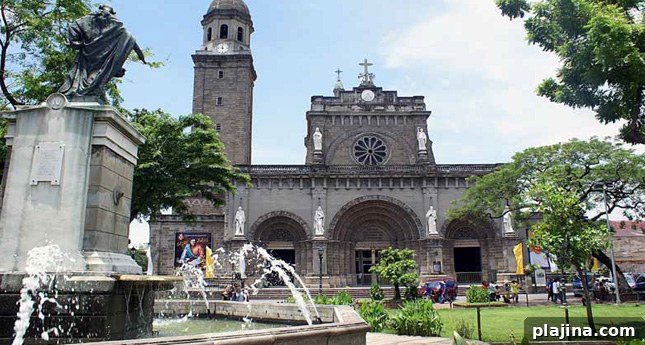
Old Manila, known as Intramuros, preserves the city’s colonial era. The walled fortress city served as the seat of government during Spanish rule from the 1500s through the 1800s. Within Intramuros, visitors can find the Manila Cathedral, one of the region’s oldest churches, and Fort Santiago, a former military fort now operating as a museum. Tours and self-guided walks allow visitors to explore Fort Santiago, San Agustin Church and Casa Manila, experiencing Manila’s layered past.
Binondo, founded in 1594 and recognized as one of the world’s oldest Chinatowns, remains an intact maze of Chinese and Filipino eateries, specialty shops and small malls, offering a glimpse into the city’s long-standing trade and cultural exchanges.
Bar at Sofitel Philippine Plaza Manila © Sofitel Philippine Plaza Manila
Manila’s combination of historical attractions and modern facilities draws major international gatherings. In 2015, the Philippines hosted APEC, a year-long series of Asia-Pacific Economic Cooperation events culminating in the APEC Economic Leaders’ Meeting in November, which gathered about 7,200 delegates. The program highlighted the country’s capacity to host large-scale, high-profile international meetings and showcased Manila’s MICE capabilities.
Event planners will find a wide selection of venues suitable for conventions and large meetings. The Philippine International Convention Center (PICC) is one of the most versatile event venues in the Asia-Pacific region, having hosted political summits, medical conferences and concerts featuring internationally acclaimed performers. Located on reclaimed land along Manila Bay, the PICC is both an architectural landmark and a repository for Filipino art, featuring paintings and sculptures by prominent national artists. Designed by National Artist for Architecture Leandro V. Locsin, the complex opened in 1976 to host the World Bank and International Monetary Fund annual meeting.
The PICC complex includes a multilevel plenary hall, 14 meeting rooms, a fine-dining restaurant and a media center. Five primary buildings form the venue: the Delegation Building, Secretariat Building, Plenary Hall, Reception Hall and The Forum. The Forum alone offers more than 43,000 square feet for exhibitions and special events. Expansion plans include a new Meeting Room 1 designed for larger gatherings with seating for up to 900 and a built-in stage. The Bangko Sentral ng Pilipinas is also developing the BSP Museum on the PICC grounds to display the central bank’s art collections and historical artifacts, alongside a planned new trade exhibit and special events hall spanning more than 61,000 square feet with flexible, divisible spaces and pre-function lobbies.
Beyond the PICC, Metro Manila boasts at least eight major convention venues, including the SMX Convention Center, the World Trade Center Metro Manila and Megatrade Hall, in addition to numerous upscale hotels in business districts that cater to meetings and events.
The World Trade Center Metro Manila provides nearly 122,000 square feet of contiguous indoor space plus 88,000 square feet of outdoor area, and more than 10,000 square feet of pre-function lobby space. SMX Manila features four exhibition halls, five function rooms and 14 meeting rooms, totaling over 225,000 square feet and accommodating up to 18,000 attendees. The Araneta Coliseum is also available for large-scale events, with seating for up to 16,500.
For cultural and leisure activities during downtime, delegates can visit the Cultural Center of the Philippines, founded in 1969 as a premier showcase for the arts. Its programming spans music, dance, theater, visual arts, literature, film and design, supported by nine resident companies, including Ballet Philippines, the Philippine Philharmonic Orchestra and the Bayanihan Philippine National Folk Dance Company.
Event planners can also book off-site performances at the Resorts World Manila Performing Arts Theater or organize group visits to the Metropolitan Museum of Manila, both offering curated cultural experiences for conference attendees.
Several hotels in Manila provide extensive meeting facilities. The Sofitel Philippine Plaza Manila offers space for up to 6,000 guests, while Dusit Thani Manila has earned EarthCheck recognition for its sustainability practices. Newer properties continue to expand the city’s capacity: AccorHotels opened the Novotel Manila Araneta Center in Quezon City, a 401-room, 24-floor hotel with a grand ballroom and meeting rooms designed for events and conferences.
With its blend of historical character, modern venues and growing hotel inventory, Manila presents a compelling choice for event planners seeking an accessible and culturally rich destination for conferences and conventions in Southeast Asia.